Read the passage carefully and answer the Questions.
A homogeneous mixture of two or more than two components has uniform composition and properties. The binary solutions have two components, which may be solid, liquid or gas. The resultant solution has a larger amount of solvent and a smaller amount of solute. The amount of solute in a given amount of solvent decides the concentration of the resulting solution. The concentration can be expressed in various ways, like molarity, molality, normality and mole fraction.
Glucose dissolved in water and ethanol dissolved in water are examples of
Answer & explanation
Correct answer: option 1
The correct answer is Option (1) → Liquid solution and liquid solution, respectively.
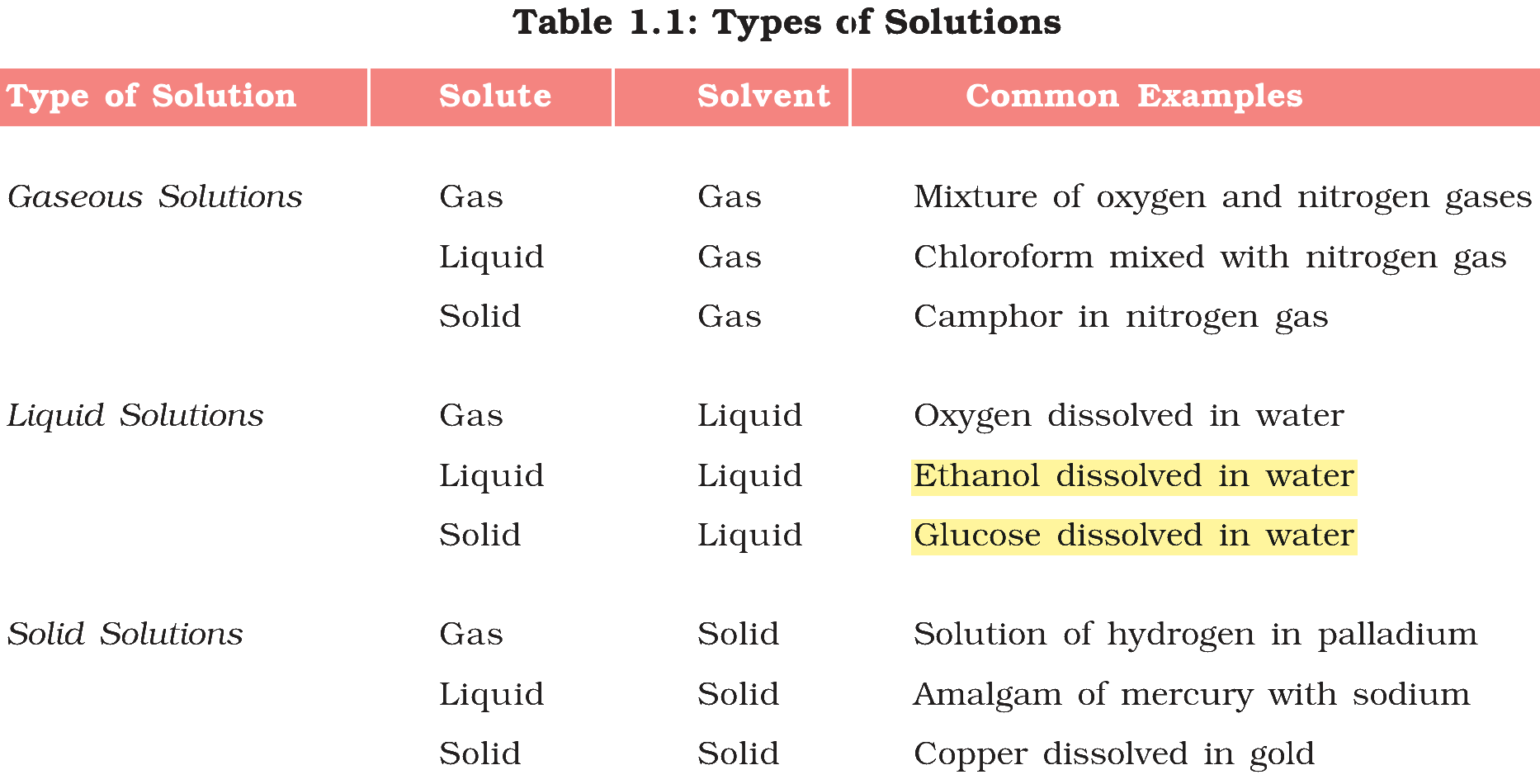
Binary solutions are classified by the physical state of the solvent, the component present in the larger amount. If the solvent is a liquid, the solution is a liquid solution, whatever the state of the solute; in the same way there are gaseous and solid solutions. A liquid solution can have a gas, a liquid or a solid as the solute.
Glucose dissolved in water: a solid solute in a liquid solvent, so it is a liquid solution.
Ethanol dissolved in water: a liquid solute in a liquid solvent, so it is also a liquid solution.
So both are liquid solutions.
Why the other options are incorrect
Option (2) Solid solution and liquid solution, respectively. — Incorrect. A solid solute does not make a solid solution; glucose solution is liquid because its solvent, water, is a liquid.
Option (3) Solid solution and solid solution, respectively. — Incorrect. A solid solution needs a solid solvent, as in copper dissolved in gold or an amalgam of mercury with sodium; here the solvent in both cases is water.
Option (4) Liquid solution and solid solution, respectively. — Incorrect. Ethanol in water has a liquid solvent, so it cannot be a solid solution.
NCERT (2026-27 edition):
Types of Solutions – …