An aromatic compound (A) on treatment with aqueous ammonia and heating forms compound (B) which on heating with Br2 and KOH forms a compound (C) of molecular formula C6H7N.
Identify (C) from the given reaction.
Answer & explanation
Correct answer: option 4
The correct answer is Option (4) → None of the above
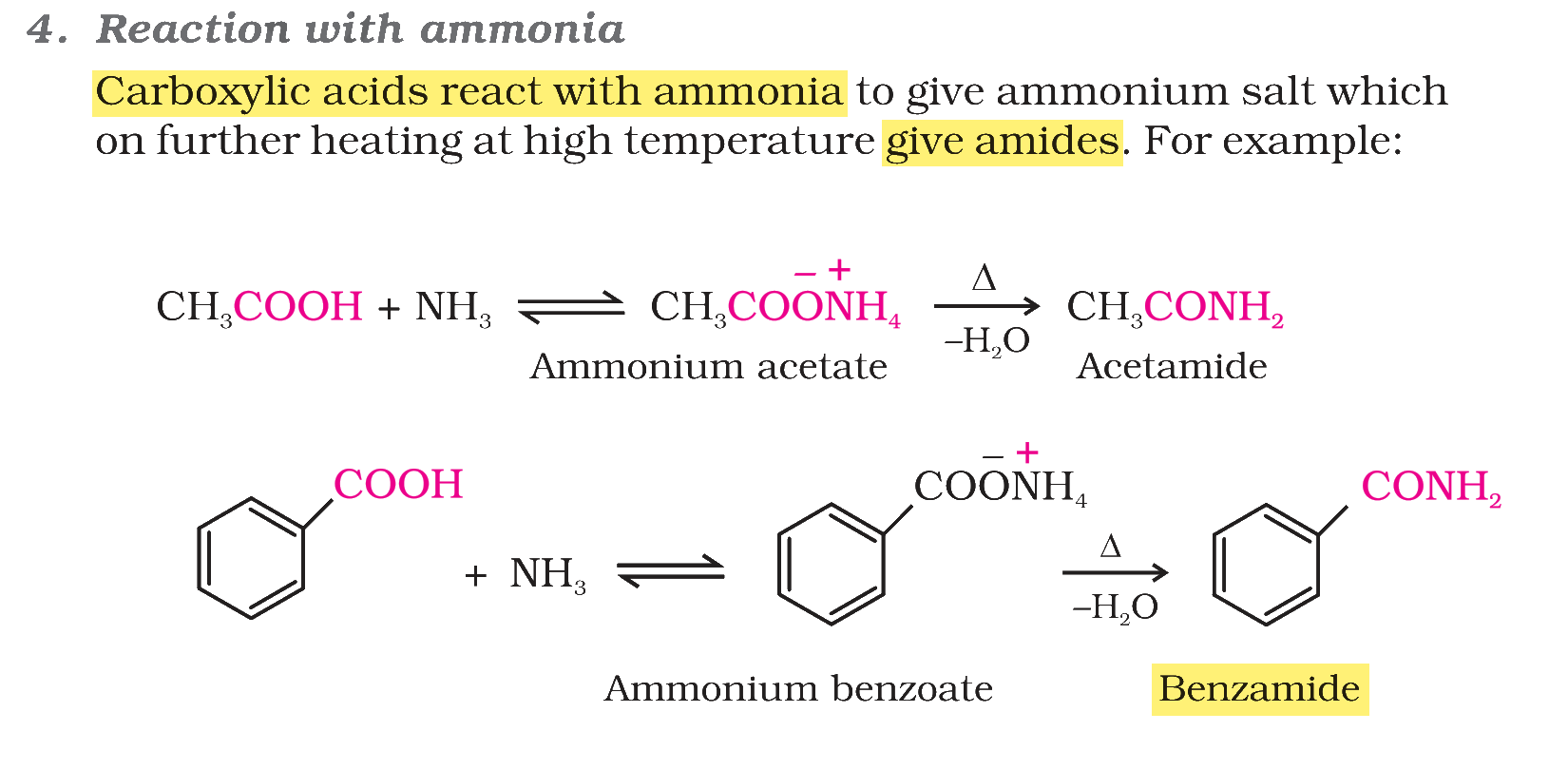
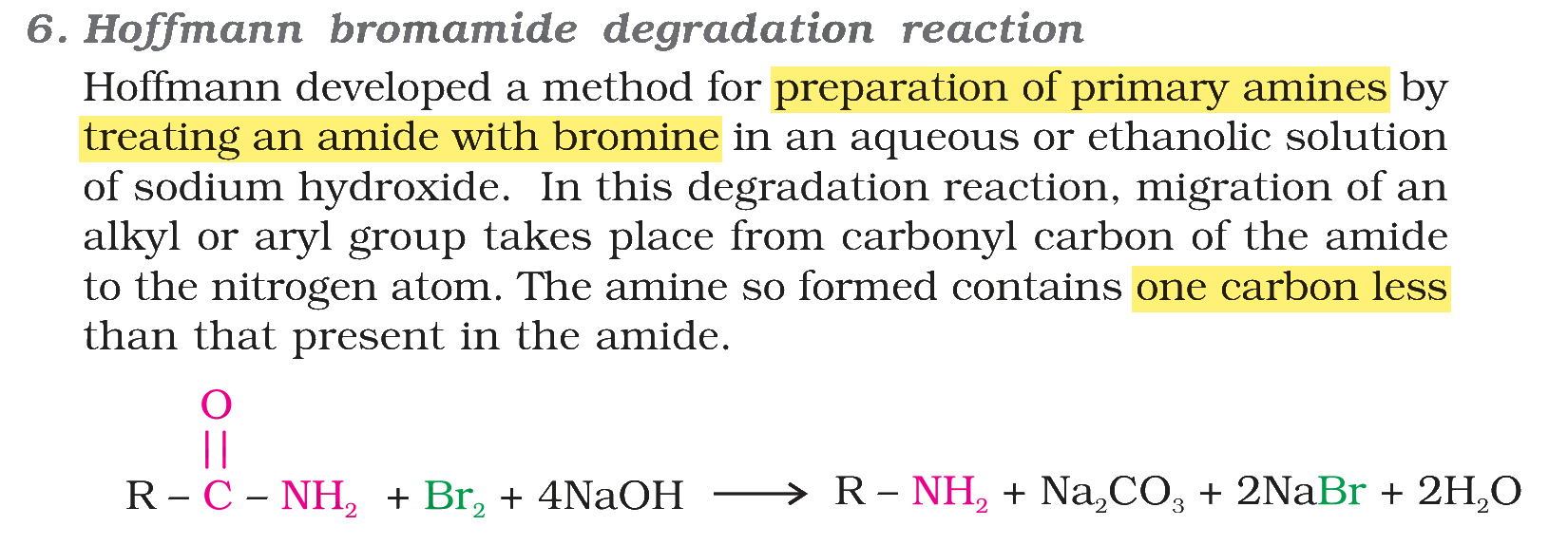
Compound (C) comes from an amide heated with \( \ce{Br2} \) and \( \ce{KOH} \): the Hoffmann bromamide degradation, which gives a primary amine with one carbon atom less. (A) is an aromatic acid, benzoic acid, which with ammonia on heating gives benzamide (B):
\( \displaystyle \ce{C6H5COOH + NH3 <=> C6H5COONH4} \)
\( \displaystyle \ce{C6H5COONH4} \xrightarrow[-\ce{H2O}]{\text{heat}} \ce{C6H5CONH2} \)
\( \displaystyle \ce{C6H5CONH2 + Br2 + 4KOH -> C6H5NH2 + K2CO3 + 2KBr + 2H2O} \)
Aniline, \( \ce{C6H5NH2} \), is \( \ce{C6H7N} \), the formula given. So (C) is aniline, which is not among the first three options.
Why the other options are incorrect
Option (1) Benzaldehyde — Incorrect. \( \ce{C6H5CHO} \) contains no nitrogen, so it cannot be \( \ce{C6H7N} \).
Option (2) Benzamide — Incorrect. Benzamide (\( \ce{C7H7NO} \)) is compound (B), the starting material, not the product.
Option (3) N-Methylaniline — Incorrect. \( \ce{C6H5NHCH3} \) (\( \ce{C7H9N} \)) is a secondary amine with seven carbons; the reaction gives a primary amine with six.
NCERT (2026-27 edition):
Preparation of Amines
Reactions Involving Cleavage of C–OH Bond