
CUETMOCK
  • Pricing
  • Mentors
Log inStart freeStart free mocks→

First test, then trust

Try a free CUET mock test.

Join 5,00,000+ students who rehearsed exam day on the exact NTA screen before sitting CUET. On the web and on Android.

Start free mocks →Get the Android app
CUETMOCK

India's #1 CUET Mock Test Platform. Original NCERT-based questions on the exact NTA exam screen — trusted by 5,00,000+ students since CUET 2022.

Get it onGoogle PlayScan to download the CUETMOCK app

Mock tests

  • CUET mock test series
  • Browse all papers
  • Commerce mocks
  • Humanities (Arts) mocks
  • Science mocks
  • Languages & GAT mocks
  • Free practice questions
  • Pricing

Resources

  • CUET exam guide
  • CUET syllabus
  • Universities accepting CUET
  • Expert blogs
  • News & notifications
  • Webinars & counselling
  • CUET score calculator
  • How we estimate your rank
  • FAQs

Company

  • About us
  • Our leadership & team
  • Our toppers
  • Mentors
  • For schools
  • Contact us
  • Terms
  • Privacy
  • Refund policy

Talk to us

+91 7696 6630 56info@cuetmock.comWhatsApp us

Our other platforms

  • JEE Mock — For IIT-JEE aspirants
  • NEET Mock — For NEET aspirants

Newsletter

Exam updates, study material and offers — no spam.

© 2026 NYC Ventures Pvt. Ltd.

701-702, Royal Business Park, Zirakpur, Punjab - 140603

  • Terms of use
  • Privacy policy
  • Refund policy
  • Contact us

iCUETMOCK is an independent preparation platform, not affiliated with the National Testing Agency (NTA). Always check exam details on the official NTA website.

  • Home
  • Mock tests
  • CUET guide
  • Pricing
  • Log in
Home/Practice questions/Biology
BiologyReproduction in Organisms

Match the Column I with Column II : Column A (Organisms) Column B (As…

Match the Column I with Column II :

Column A (Organisms) Column B (Asexual reproductive structure)
(a) Penicillium (I) Gemmules 
(b) Sponge  (II) Zoospores 
(c) Chlamydomonas  (III) Conidia  
(d) Hydra  (IV) Buds


Answer & explanation+

Correct answer: option 3

The correct answer is Option (3) – a-III, b-I, c-II, d-IV.

Column A (Organisms) Column B (Asexual reproductive structure)
(a) Penicillium (III) Conidia
(b) Sponge  (I) Gemmules
(c) Chlamydomonas  (II) Zoospores
(d) Hydra  (IV) Buds

Members of the Kingdom Fungi and simple plants such as algae reproduce through special asexual reproductive structures. The most common of these structures are zoospores that usually are microscopic motile structures. Other common asexual reproductive structures are conidia (Penicillium), buds (Hydra) and gemmules (sponge), Zoospores of Chlamydomonas.
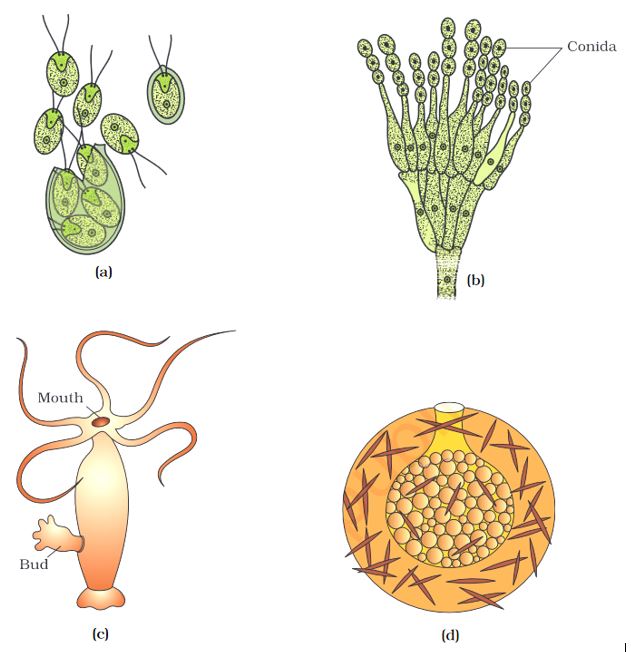
Asexual reproductive structures: (a) Zoospores of Chlamydomonas; (b) Conidia of Penicillium; (c) Buds in Hydra ; (d) Gemmules in sponge

Advertisement

Practise more on Reproduction in Organisms

Chapter-wise mocks on the real NTA exam screen, with solutions and your rank. Your first mocks are free.

Start free mocks →

Advertisement

Next questions

  1. In an ecosystem, the vertical distribution of different species occupying different levels is called.Biology · Ecosystem
  2. Match Column I with Column II.Column IColumn II1. Threshold (cut-in) voltage of a Ge diodeA. 0.7 V2. Threshold (cut-in) voltage of a Si dio…Physics · Semiconductors and Electronic Devices
  3. Which of the following is NOT an example of high tech industry?Geography · Fundamentals of Human Geography: Secondary Activities
  4. Which one of the following is the length of Panama Canal?Geography · Fundamentals of Human Geography: Transport and Communication
  5. For principal quantum number n = 3, the possible values of orbital quantum number ‘l’ arePhysics · Atoms
  6. The value of cos ≤ft[tan^-1 […] ]=Maths. Section B1 · Inverse Trigonometric Functions
  7. Select the word that is closest in meaning to the given word.ZANYEnglish · Synonyms
  8. Match List-I with List-IIList-IList-II(A) C + I + G + (X - M) + NFIA(I) GDPMP(B) GDPMP – Depreciation(II) Domestic Income(C) NDPMP - IT + S…Economics · Macro Economics: National Income Accounting
  9. How will you classify, if the operating cycle of the company is 10 months and the expected period of payment of trade payables is 12 months?Accountancy Part B · Financial Statements of a Company
  10. An individual buys 15 kg of sugar when its price is Rs. 5 per kg. When the price increases to Rs. 7 per kg, the demand goes down to 12 kg o…Economics · Micro Economics: Theory of Consumer behaviour