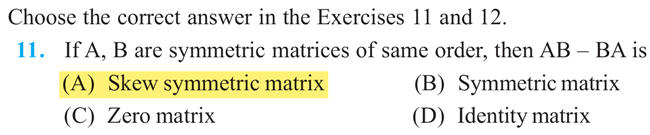
If A and B are symmetric matrices, then AB − BA is
Answer & explanation
Correct answer: option 4
The correct answer is Option (4) → Skew symmetric matrix
Since A and B are symmetric, \(A^T = A\) and \(B^T = B\). Using the reversal law \((PQ)^T = Q^TP^T\):
\((AB - BA)^T = B^TA^T - A^TB^T\)
\(= BA - AB\)
\(= -(AB - BA)\)
So AB − BA is always skew-symmetric.
The other options need not hold. For example, take the symmetric matrices
\( \displaystyle A = \begin{bmatrix}1&0\\0&0\end{bmatrix},\quad B = \begin{bmatrix}0&1\\1&0\end{bmatrix} \)
\( \displaystyle AB - BA = \begin{bmatrix}0&1\\0&0\end{bmatrix} - \begin{bmatrix}0&0\\1&0\end{bmatrix} = \begin{bmatrix}0&1\\-1&0\end{bmatrix} \)
Why the other options are incorrect
Option (1) Singular matrix — Incorrect. In the example \(|AB - BA| = 0 + 1 = 1 \ne 0\). A skew-symmetric matrix of odd order is always singular, but one of even order need not be.
Option (2) Zero matrix — Incorrect. AB − BA = O only when AB = BA; the example gives a non-zero matrix.
Option (3) Symmetric matrix — Incorrect. A matrix that is both symmetric and skew-symmetric is O; the example is not symmetric (entries 1 and −1).
NCERT (2026-27 edition):
Symmetric and Skew Symmetric Matrices