
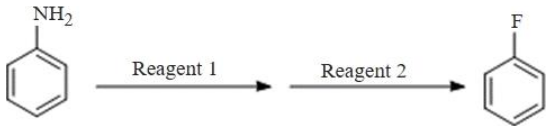
The correct reagents (Reagent 1 and Reagent 2) required for the following chemical transformation are ..................... and ....................., respectively.
Answer & explanation
Correct answer: option 1
The correct answer is Option (1) → Reagent 1: NaNO2/HCl/0-5 °C Reagent 2: HBF4 followed by heating
A primary aromatic amine is first converted into a diazonium salt (diazotisation): it is treated with nitrous acid, made in the solution from NaNO2 and HCl, at 0–5 °C (the salt decomposes if warmer). The –\( \ce{N2^{+}} \) group can then be replaced by many groups:
–Cl, –Br, –CN: \( \ce{Cu2Cl2} \)/HCl, \( \ce{Cu2Br2} \)/HBr, CuCN/KCN (Sandmeyer), or Cu powder with HX (Gattermann).
–I: warming with KI.
–F: treatment with fluoroboric acid (HBF4) precipitates the diazonium fluoroborate, which on heating gives the aryl fluoride (Balz–Schiemann reaction).
\( \displaystyle \ce{C6H5NH2} \xrightarrow[\text{0-5}\,^{\circ}\text{C}]{\ce{NaNO2 + HCl}} \ce{C6H5N2^+Cl^-} \)
\( \displaystyle \ce{C6H5N2^+Cl^-} \xrightarrow{\ce{HBF4}} \ce{C6H5N2^+BF4^-} \xrightarrow{\Delta} \ce{C6H5F + BF3 + N2} \)
So Reagent 1 is NaNO2/HCl at 0–5 °C and Reagent 2 is HBF4 followed by heating.
Why the other options are incorrect
Option (2) Reagent 2: HF — Incorrect. The diazonium group is not replaced by fluorine on treatment with HF; fluorine is introduced through the fluoroborate.
Option (3) Reagent 1: NaNO3/HCl/0-5 °C — Incorrect. Sodium nitrate does not give nitrous acid, so no diazonium salt forms. Diazotisation needs sodium nitrite.
Option (4) — Incorrect. Both reagents are wrong, for the reasons above.
NCERT (2026-27 edition):
Method of Preparation of Diazonium Salts – “Benzenediazonium chloride is prepared by the reaction of aniline with nitrous acid at 273-278K. Nitrous acid is produced in the reaction mixture by the reaction of sodium nitrite with hydrochloric acid. The conversion of primary aromatic amines into diazonium salts is known as diazotisation. Due to its instability, the diazonium salt is not generally stored and is used immediately after its preparation.”
Reactions Involving Displacement of Nitrogen – “… 3. Replacement by fluoride ion: When arenediazonium chloride is treated with fluoroboric acid, arene diazonium fluoroborate is precipitated which on heating decomposes to yield aryl fluoride.”