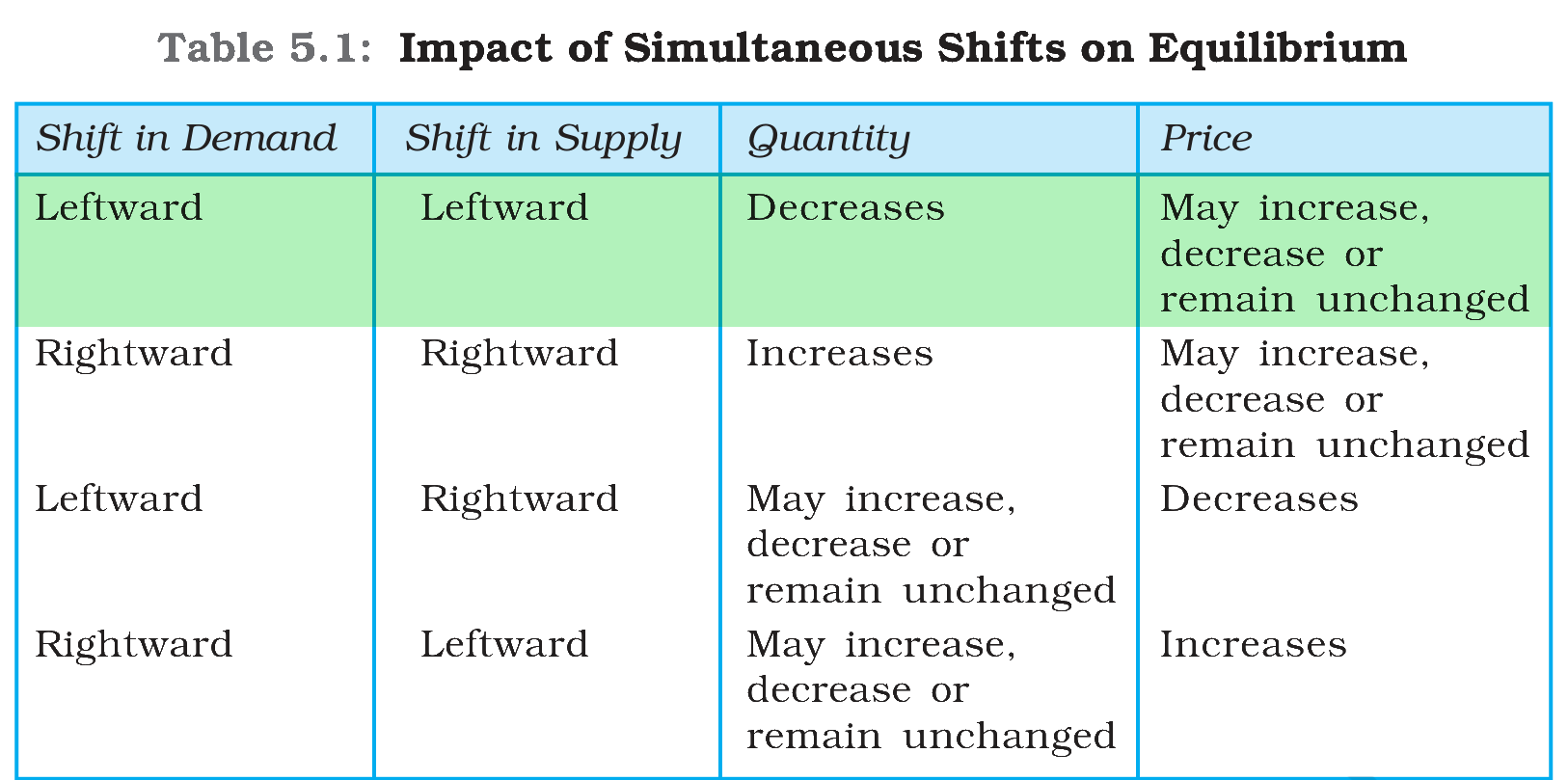
Consumers’ incomes fall and, at the same time, some firms leave the market for a normal good. What can be said about the new equilibrium?
Answer & explanation
Correct answer: option 1
The correct answer is Option (1) → The quantity falls; the price may rise, fall or remain unchanged
A normal good is one whose demand moves with income. So a fall in income shifts the demand curve to the left. Fewer firms offer less at every price, so the supply curve also shifts left.
When both curves shift left, the quantity falls for sure. The price may rise, fall or stay the same, depending on the size of the two shifts.
This question uses Theory of Consumer Behaviour and Market Equilibrium together.
NCERT (2026-27): “Simultaneous Shifts of Demand and Supply … In the first two cases which are shown in the first two rows of the table, the impact on equilibrium quantity is unambiguous but the equilibrium price may change, if at all, in either direction depending on the magnitudes of shifts. In the next two cases, shown in the last two rows of the table, the effect on price is unambiguous whereas effect on quantity depends on the magnitude of shifts in the two curves.”
Introductory Microeconomics, Chapter 2 (Theory of Consumer Behaviour): “Summary … The demand for a normal good increases (decreases) with increase (decrease) in the consumer’s income.” |