
Identify the most acidic compound
Answer & explanation
Correct answer: option 3
The correct answer is Option (3) → (C)
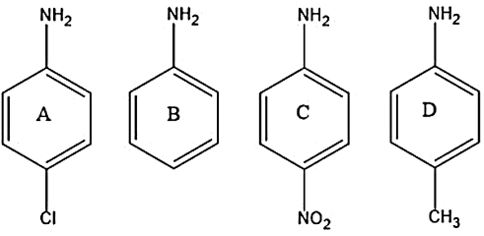
The four compounds are aniline and three para-substituted anilines. The acidic hydrogen is the N–H hydrogen; losing it leaves a negative charge on nitrogen. A substituent that withdraws electrons from the ring pulls this charge (and the lone pair of nitrogen) into the ring and stabilises the anion, so it makes the N–H more acidic. The same pull makes the lone pair less available, so the most acidic aniline is also the weakest base. An electron-donating group does the opposite.
(A) 4-Chloroaniline: Cl withdraws electrons by its −I effect, partly offset by its +R effect; more acidic than aniline.
(B) Aniline: no substituent; the reference compound.
(C) 4-Nitroaniline: the –\( \ce{NO2} \) group withdraws electrons by both −I and −R effects; from the para position the charge on nitrogen is delocalised right onto the oxygen atoms of the nitro group.
(D) 4-Methylaniline (p-toluidine): –\( \ce{CH3} \) donates electrons (+I and hyperconjugation); the least acidic.
The order of acidity is (C) > (A) > (B) > (D), so the most acidic compound is (C), 4-nitroaniline.
Why the other options are incorrect
Option (1) (A) — Incorrect. Chlorine withdraws electrons only by induction, and its lone pairs give some back by resonance, so its effect is much weaker than that of a nitro group.
Option (2) (B) — Incorrect. Aniline has no electron-withdrawing group, so its N–H is less acidic than that of the chloro and nitro compounds.
Option (4) (D) — Incorrect. The methyl group pushes electrons into the ring and destabilises the anion, so p-toluidine is the least acidic (and the most basic) of the four.
Note: The question is from beyond the NCERT textbook.