
CUETMOCK
  • Pricing
  • Mentors
Log inStart freeStart free mocks→

First test, then trust

Try a free CUET mock test.

Join 5,00,000+ students who rehearsed exam day on the exact NTA screen before sitting CUET. On the web and on Android.

Start free mocks →Get the Android app
CUETMOCK

India's #1 CUET Mock Test Platform. Original NCERT-based questions on the exact NTA exam screen — trusted by 5,00,000+ students since CUET 2022.

Get it onGoogle PlayScan to download the CUETMOCK app

Mock tests

  • CUET mock test series
  • Browse all papers
  • Commerce mocks
  • Humanities (Arts) mocks
  • Science mocks
  • Languages & GAT mocks
  • Free practice questions
  • Pricing

Resources

  • CUET exam guide
  • CUET syllabus
  • Universities accepting CUET
  • Expert blogs
  • News & notifications
  • Webinars & counselling
  • CUET score calculator
  • How we estimate your rank
  • FAQs

Company

  • About us
  • Our leadership & team
  • Our toppers
  • Mentors
  • For schools
  • Contact us
  • Terms
  • Privacy
  • Refund policy

Talk to us

+91 7696 6630 56info@cuetmock.comWhatsApp us

Our other platforms

  • JEE Mock — For IIT-JEE aspirants
  • NEET Mock — For NEET aspirants

Newsletter

Exam updates, study material and offers — no spam.

© 2026 NYC Ventures Pvt. Ltd.

701-702, Royal Business Park, Zirakpur, Punjab - 140603

  • Terms of use
  • Privacy policy
  • Refund policy
  • Contact us

iCUETMOCK is an independent preparation platform, not affiliated with the National Testing Agency (NTA). Always check exam details on the official NTA website.

  • Home
  • Mock tests
  • CUET guide
  • Pricing
  • Log in
Home/Practice questions/Fine Arts
Fine ArtsThe Modern Indian Art

What material did P. V. Janakiram use to create the sculpture "Ganesh…

What material did P. V. Janakiram use to create the sculpture "Ganesha"?

Answer & explanation+

Correct answer: option 1

The correct answer is Option 1 -  Copper
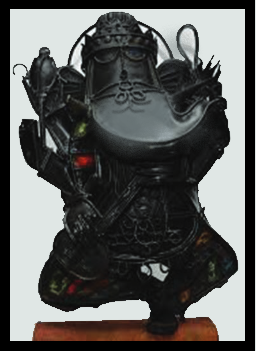


Ganesha- This is a sculpture in oxidised copper made by P. V. Janakiram in 1970, and is in the collection of NGMA, Delhi. He has used sheets of copper to create pictorial sculpture as free-standing forms, and ornamented their surface with linear elements. Metal sheets are beaten into concave planes on which are welded linear details. These linear elements work as facial features and decorative motifs to suggest religious icons, inviting intimate contemplation. Janakiram is influenced by the ancient temple sculpture of South India. The image of Ganesha, crafted frontally, lends an important indigenous character of cave and temple sculpture. In this sculpture, Ganesha is palying vina, a musical instrument. Details on the sculpture and technical blending of material, nevertheless, reveal his meticulous craftsmanship. He also experimented with the ‘open- endedness’ quality of indigenous workmanship. Ganesha reveals his understanding of traditional imagery. He has elaborated linear details into overall form. The sculpture is conceived in terms of linear silhouettes instead of emphasis on three-dimensionality, despite its volume. Rhythm and growth are incorporated through lyrical stylisation. It is also an amalgamation of folk and traditional craftsmanship.

Advertisement

Practise more on The Modern Indian Art

Chapter-wise mocks on the real NTA exam screen, with solutions and your rank. Your first mocks are free.

Start free mocks →

Advertisement

Next questions

  1. Which of the following triggers the activation of the toxin of Bacillus thuringiensis?Biology · Biotechnology and its Applications
  2. The system described in the passage is possible due to which process?Sociology · Social Change and Development in India: Change and Development in Rural Society
  3. निम्नलिखित में से कौन-सा शब्द तत्सम नहीं है?Hindi · शब्द भेद (तत्सम, तद्भव, देशज, विदेशज)
  4. Identify the nucleophile in the substitution reaction between water and bromopropane.Chemistry · Organic: Haloalkanes and Haloarenes
  5. Which metal has the highest oxidation state in the first row transition series ?Chemistry · Inorganic: D and F Block Elements
  6. In which year did Rao Bika Rathore establish the kingdom of Bikaner?Fine Arts · The Rajasthani Schools of Painting
  7. If a, b, c are three non-coplanar unit vectors, then [a p q] a+mid b p q] b+[c p q] c is equal toMaths. Section B1 · Vectors
  8. Irregular trends in a time series are caused by (A) Epidemics(B) Strikes(C) Festival season(D) Floods Choose the correct answer from the op…Applied Maths. Section B2 · Index Numbers and Time Based Data
  9. The least number which is exactly divisible by 5, 6, 8, 10 and 12 is:General Aptitude Test · Numerical Ability
  10. Assertion:. The human poverty index is related to the human development index. Reasoning: Often the human poverty index is more revealing t…Geography · Fundamentals of Human Geography: Human Development