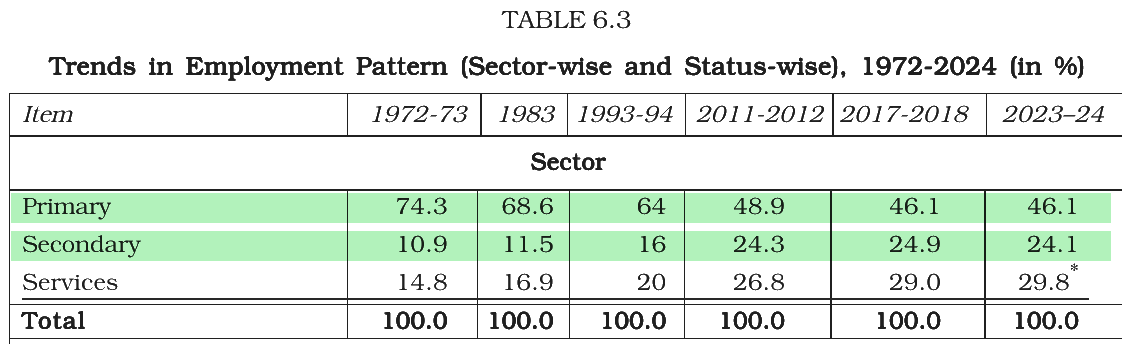
Consider the following statements about the distribution of India’s workforce by sector:
(A) In 1972-73, about three-fourths of the workforce was in the primary sector.
(B) By 2023-24, the share of the primary sector had fallen to about 46 per cent.
(C) The share of the secondary sector more than doubled between 1972-73 and 2023-24.
(D) The share of the service sector fell between 1972-73 and 2023-24.
(E) Between 2017-18 and 2023-24, the share of the primary sector fell sharply.
Choose the correct answer from the options given below:
Answer & explanation
Correct answer: option 1
The correct answer is Option (1) → (A), (B) and (C) only
(A) In 1972-73, about three-fourths of the workforce was in the primary sector. — Correct. It was about 74 per cent.
(B) By 2023-24, the share of the primary sector had fallen to about 46 per cent. — Correct. Workers shifted from farm to non-farm work.
(C) The share of the secondary sector more than doubled between 1972-73 and 2023-24. — Correct. It rose from about 11 to about 24 per cent.
(D) The share of the service sector fell between 1972-73 and 2023-24. — Incorrect. It rose from 15 to 30 per cent.
(E) Between 2017-18 and 2023-24, the share of the primary sector fell sharply. — Incorrect. It stayed at about 46 per cent in both years.
NCERT (2026-27): “6.6 Growth and Changing Structure of Employment … Distribution of workforce by industrial sectors shows substantial shift from farm work to non-farm work (see Table 6.3). In 1972-73, about 74 per cent of workforce was engaged in primary sector and in 2023-24, this proportion has declined to about 46 per cent. Secondary and service sectors are showing promising future for the Indian workforce. You may notice that the shares of these sectors have increased from 11 to 24 per cent and 15 to 30 per cent, respectively. …”
|