
Take the statements below to be true, even if they differ from known facts. Which of the conclusions follow logically from them?
Statements:
1. All poets are readers.
2. All poets are walkers.
Conclusions:
I. All readers are walkers.
II. Some readers are not walkers.
Answer & explanation
Correct answer: option 4
The correct answer is Option (4) → Either conclusion I or conclusion II follows
When two conclusions do not follow on their own, but in every diagram exactly one of them is true (such as “all X are Y” and “some X are not Y”), the answer is “either one or the other follows”.
“All poets are readers”: the circle of poets lies inside the circle of readers
“All poets are walkers”: the circle of poets also lies inside the circle of walkers; the readers who are not poets may or may not be walkers
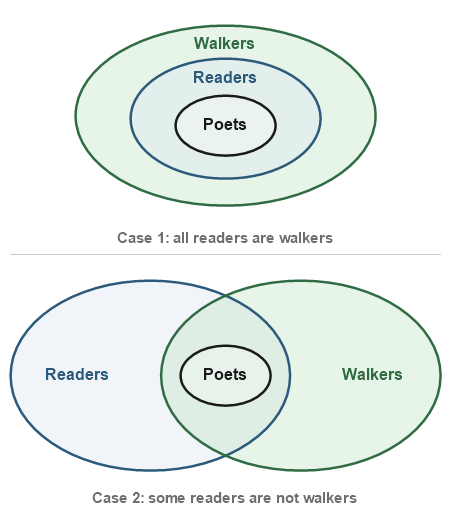
Conclusion I: All readers are walkers. — Does not follow on its own. In case 2 some readers lie outside the walkers, so it is false there.
Conclusion II: Some readers are not walkers. — Does not follow on its own. In case 1 every reader is a walker, so it is false there.
Either every reader is a walker or at least one reader is not; there is no third case. So in every diagram exactly one of I and II is true: either conclusion I or conclusion II follows.