Let the exchange rate between US dollar and Indian rupee be ₹60/US dollar. Now it changes to ₹40/US dollar. What is the reason behind appreciation of Indian rupee?
Answer & explanation
Correct answer: option 4
The correct answer is Option (4) → Decrease in demand of US dollar and increase in supply of US dollar
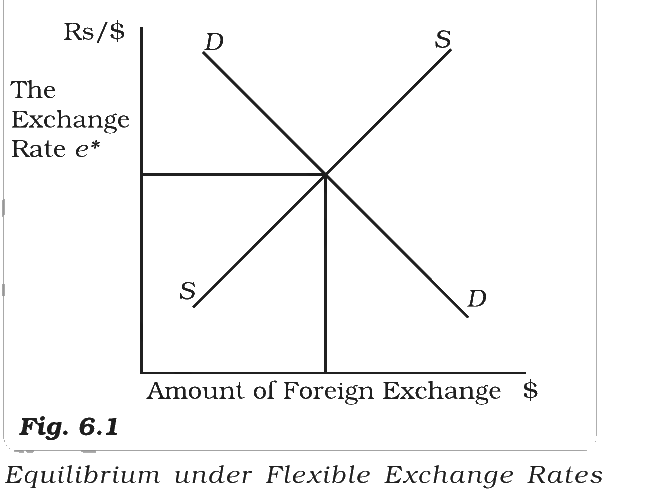
The rupee appreciates when fewer rupees buy a dollar, here from Rs 60 to Rs 40. Under a flexible rate, the price of the dollar falls when its demand falls and its supply rises.
Option (1) Increase in demand and supply of US dollar to same extent — Incorrect. Equal shifts in both leave the price roughly the same.
Option (2) Decrease in demand and supply of US dollar to same extent — Incorrect. Again the two shifts cancel out in price.
Option (3) Increase in demand of US dollar and decrease in supply of US dollar — Incorrect. This makes the dollar dearer, so the rupee depreciates.
Option (4) Decrease in demand of US dollar and increase in supply of US dollar — Correct. Both changes push the price of the dollar down.
NCERT (2026-27): “Flexible Exchange Rate This exchange rate is determined by the market forces of demand and supply. It is also known as Floating Exchange Rate. As depicted in Fig. 6.1, the exchange rate is determined where the demand curve intersects with the supply curve, i.e., at point e on the Y – axis. Point q on the x – axis determines the quantity of US Dollars that have been demanded and supplied on e exchange rate. …” “Interest Rates and the Exchange Rate … This means that the demand curve for country A’s currency will shift to the left and the supply curve will shift to the right causing a depreciation of country A’s currency and an appreciation of country B’s currency. …”
|