A man wants to get Rs. 10,000 forever at the beginning of each quarter, if the money is worth 8% per annum compounded quarterly, then the money he needed to invest now is
Answer & explanation
Correct answer: option 2
The correct answer is Option (2) → Rs. 5,10,000
Payments at the beginning of each period, forever, form a perpetuity due. The rate per quarter is
\( \displaystyle i=\frac{8\%}{4}=2\%=0.02 \)
The present value of a perpetuity due is the first payment now plus an ordinary perpetuity:
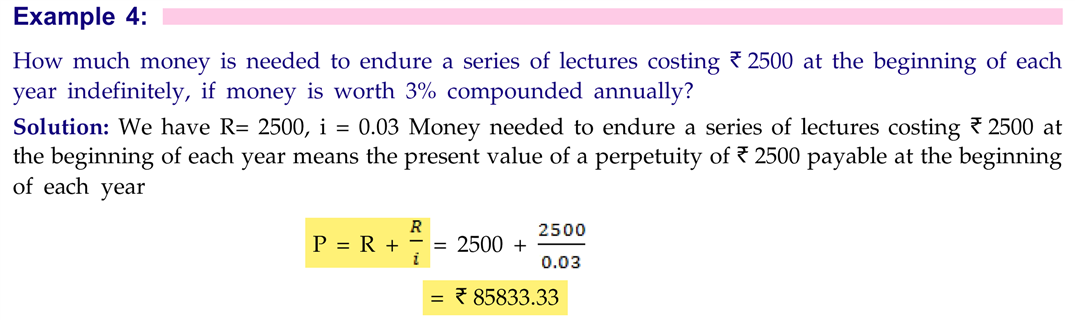
\( \displaystyle P=R+\frac{R}{i} \)
\( \displaystyle =10000+\frac{10000}{0.02} \)
\( \displaystyle =10000+500000 \)
\( \displaystyle =510000 \)
He needs to invest Rs. 5,10,000.
Why the other options are incorrect
Option (1) Rs. 5,00,000 — Incorrect. Rs. 5,00,000 is \( \frac{R}{i} \), the value of an ordinary perpetuity with payments at the end of each quarter; the first payment, due now, is missing.
Option (3) Rs. 1,25,000 — Incorrect. Rs. 1,25,000 is \( \frac{10000}{0.08} \), using the annual rate with quarterly payments.
Option (4) Rs. 12,50,000 — Incorrect. Rs. 12,50,000 would need a rate of only 0.8% per quarter \( \left(\frac{10000}{0.008}\right) \); the quarterly rate is 2%.
CBSE Applied Mathematics (Class XII):
Perpetuity