Read the passage and answer the question:
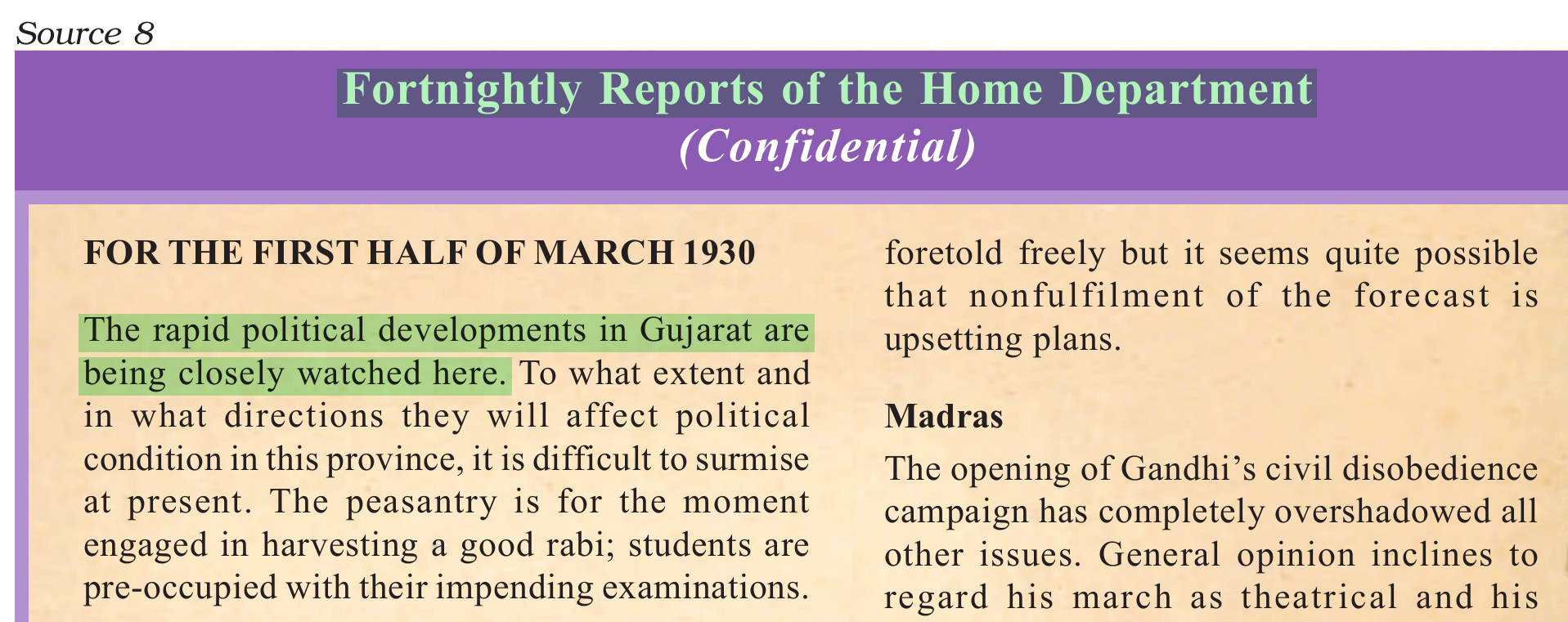
"The rapid political developments in Gujarat are being closely watched here. To what extent and in what directions they will affect political condition in this province, it is difficult to surmise at present. The peasantry is for the moment engaged in harvesting a good rabi, students are pre-occupied with their impending examination".
The passage shows that the government considered the 'political development' as:
Answer & explanation
Correct answer: option 1
The correct answer is Option (1) → Drama to mobilise masses.
The passage comes from the Fortnightly Reports of the Home Department for the first half of March 1930, the days of the Salt March. The report watches the developments in Gujarat from a distance and stresses that the peasants are busy with the rabi harvest and the students with their examinations. Officials were unwilling to accept that Gandhiji’s actions had stirred the masses.
Option (1) Drama to mobilise masses. — Correct. In these reports the march was seen as a drama, an antic, a desperate effort to mobilise people who were unwilling to rise against the British and were busy with their daily schedules, happy under the Raj.
Option (2) A rebellion. — Incorrect. The officials did notice the possibility of sedition and rebellion, but they assured themselves that these fears were unwarranted. The report calls the effect of the events “difficult to surmise”; it does not treat them as a rising against the government.
Option (3) A movement led by the peasantry. — Incorrect. The report says the peasantry is engaged in harvesting a good rabi. The peasants are shown busy with their fields, not leading the movement.
Option (4) A high level of mass participation. — Incorrect. This is the very opposite of what the officials wanted to believe. They refused to see any enthusiastic response from the masses to Gandhiji’s march.
NCERT (2026-27): “6.3 Through police eyes … Another vital source is government records, for the colonial rulers kept close tabs on those they regarded as critical of the government. The letters and reports written by policemen and other officials were secret at the time; but now can be accessed in archives. Let us look at one such source: the fortnightly reports that were prepared by the Home Department from the early twentieth century. These reports were based on police information from the localities, but often expressed what the higher officials saw, or wanted to believe. While noticing the possibility of sedition and rebellion, they liked to assure themselves that these fears were unwarranted.… …If you see the Fortnightly Reports for the period of the Salt March you will notice that the Home Department was unwilling to accept that Mahatma Gandhi’s actions had evoked any enthusiastic response from the masses. The march was seen as a drama, an antic, a desperate effort to mobilise people who were unwilling to rise against the British and were busy with their daily schedules, happy under the Raj.”
|