
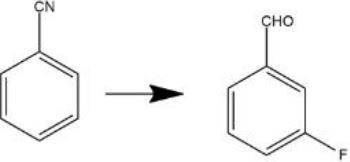
The correct sequence of reagents to carry out the following conversion is:
Answer & explanation
Correct answer: option 2
The correct answer is Option (2) → (i) \(Conc.HNO_3/Conc.H_2SO_4\) (ii) \(Sn/HCl\) (iii) \(DIBAL-H\) (iv) \(NaNO_2/HCl\) (v) \(HBF_4\)
Benzonitrile has to become 3-fluorobenzaldehyde: a fluorine atom must enter meta to the carbon chain, and the –CN group must become –CHO. Fluorine cannot be put on the ring directly; it is introduced through a diazonium salt, which is made from an amine, which in turn comes from a nitro group. The –CN group is a meta director, so the nitro group has to be put in first, while –CN is still there.
First, benzonitrile is nitrated. The electron-withdrawing –CN group sends the nitronium ion to the meta position:
\( \displaystyle \ce{C6H5CN + HNO3} \xrightarrow[\text{conc. }\ce{H2SO4}]{\text{conc.}} m\text{-}\ce{O2N-C6H4-CN + H2O} \)
Next, Sn/HCl reduces the nitro group to an amino group:
\( \displaystyle m\text{-}\ce{O2N-C6H4-CN} \xrightarrow{\ce{Sn/HCl}} m\text{-}\ce{H2N-C6H4-CN} \)
DIBAL-H then reduces the nitrile to an imine, which is hydrolysed to the aldehyde:
\( \displaystyle m\text{-}\ce{H2N-C6H4-CN} \xrightarrow[\text{(ii) }\ce{H2O}]{\text{(i) DIBAL-H}} m\text{-}\ce{H2N-C6H4-CHO} \)
The amino group is diazotised with nitrous acid (from \( \ce{NaNO2} \) and HCl) at 273–278 K:
\( \displaystyle m\text{-}\ce{H2N-C6H4-CHO + NaNO2 + 2HCl} \xrightarrow{\text{273--278 K}} m\text{-}\ce{OHC-C6H4-N2^+Cl^- + NaCl + 2H2O} \)
Finally, fluoroboric acid precipitates the diazonium fluoroborate, which on heating loses nitrogen and boron trifluoride and leaves the fluoro compound (Balz–Schiemann reaction):
\( \displaystyle \ce{ArN2^+Cl^- + HBF4 -> ArN2^+BF4^- + HCl} \)
\( \displaystyle \ce{ArN2^+BF4^-} \xrightarrow{\Delta} \ce{ArF + BF3 + N2} \)
Shortcut: The fluorine comes from a diazonium salt, the diazonium salt from an amine, the amine from a nitro group. So nitration must be the first step and \( \ce{HBF4} \) the last, which only Option (2) does.