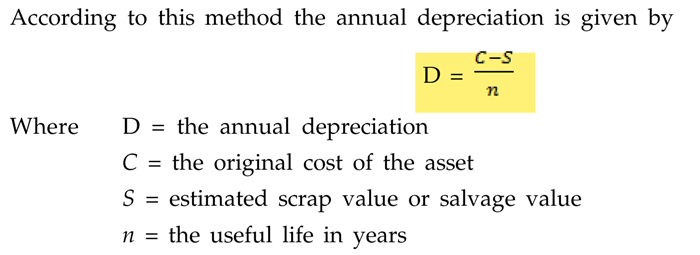
If \(C\) is the original value of the asset, \(S\) is the scrap value, \(n\) is the useful life of the asset and \(D\) is the annual depreciation, then
Answer & explanation
Correct answer: option 4
The correct answer is Option (4) → \(D = \displaystyle\frac{C-S}{n}\)
Under the linear (straight line) method, the asset loses the same amount every year. Over its useful life of n years the total loss in value is the original value minus the scrap value, \(C - S\). Sharing it equally over n years:
\( \displaystyle D = \frac{C - S}{n} \)
CBSE Applied Mathematics (Class XII):
Depreciation