
In Werner’s experiments, 1 mol of the purple complex CoCl3.5NH3 gave 2 mol of AgCl with an excess of silver nitrate solution in cold. Assuming complete dissociation, what is the van’t Hoff factor, i, for a dilute aqueous solution of this complex?
Answer & explanation
Correct answer: option 4
The correct answer is Option (4) → 3
The two chloride ions precipitated as AgCl lie outside the square brackets. The rest of the compound stays together as one complex ion, \( \ce{[CoCl(NH3)5]^2+} \). For complete dissociation, i is the number of moles of particles formed from one mole of the solute.
\( \ce{[CoCl(NH3)5]Cl2 -> [CoCl(NH3)5]^2+ + 2Cl^-} \)
\( \displaystyle i = \frac{\text{moles of particles after dissociation}}{\text{moles of particles before dissociation}} = \frac{1 + 2}{1} = 3 \)
NCERT (2026-27 edition):
5.1 Werner’s Theory of Coordination Compounds – “1 mol CoCl3.6NH3 (Yellow) gave 3 mol AgCl
1 mol CoCl3.5NH3 (Purple) gave 2 mol AgCl
1 mol CoCl3.4NH3 (Green) gave 1 mol AgCl
1 mol CoCl3.4NH3 (Violet) gave 1 mol AgCl”
“…the compounds are formulated as shown in Table 5.1, where the atoms within the square brackets form a single entity which does not dissociate under the reaction conditions.”
1.7 Abnormal Molar Masses – “In 1880 van’t Hoff introduced a factor i, known as the van’t Hoff factor, to account for the extent of dissociation or association. This factor i is defined as:”
\( \displaystyle i = \frac{\text{Total number of moles of particles after association/dissociation}}{\text{Number of moles of particles before association/dissociation}} \)
“…For example, the value of i for aqueous KCl solution is close to 2…”
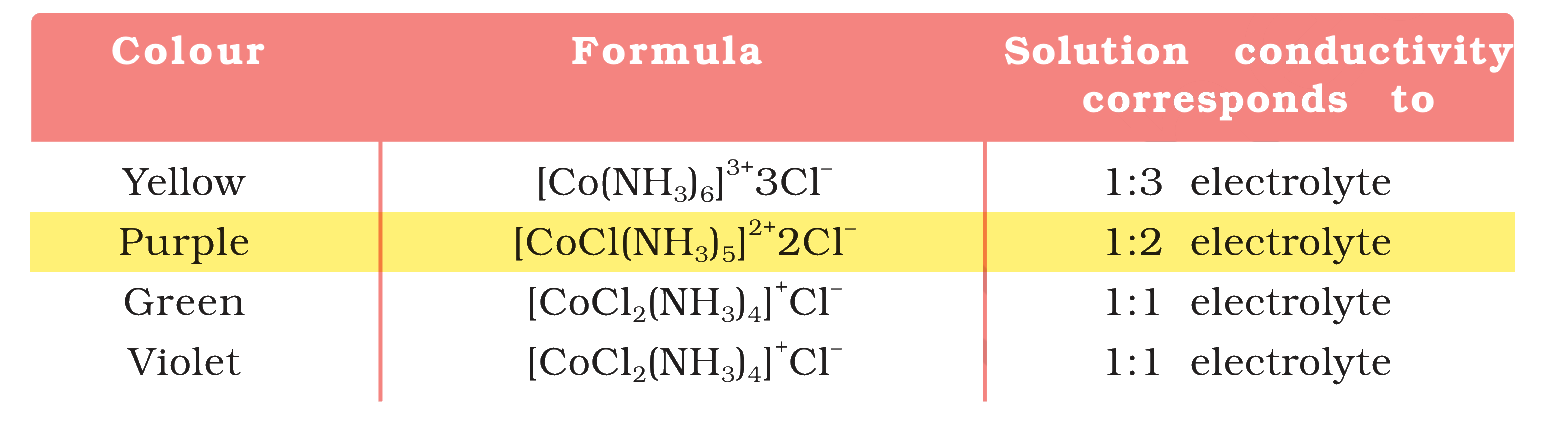
Table 5.1: Formulation of Cobalt(III) Chloride-Ammonia Complexes