
A class visits a museum gallery on the Harappan civilisation. The first case holds a small terracotta figure of an animal beside charred grains from Harappan sites; its label asks how these people farmed their fields. The second case holds two seals found in distant lands: one is a cylinder seal of a type common in Mesopotamia, the other was found at a distant coastal site. A third panel quotes an ancient Mesopotamian myth that speaks of a bird from Meluhha, a land that may have been the Harappan region. The guide reminds the students that each object is a clue that archaeologists must interpret with care.
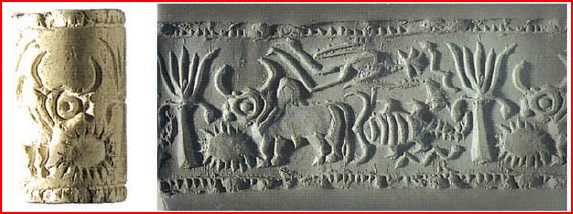
The cylinder seal in the second case is shown. Its humped bull motif appears to be derived from which region?
Answer & explanation
Correct answer: option 2
The correct answer is Option (2) → Indus
Option (1) Mesopotamia — Incorrect. Mesopotamia gives the seal its form, since the cylinder seal is its typical type. The humped bull motif on it is not Mesopotamian.
Option (2) Indus — Correct. The seal is a Mesopotamian cylinder seal, but its humped bull motif appears to be derived from the Indus region. So one object carries signs of contact between the Harappans and Mesopotamia.
Option (3) Dilmun — Incorrect. Dilmun was probably the island of Bahrain. Its round "Persian Gulf" seals sometimes carry Harappan motifs, but the motif on this cylinder seal is traced to the Indus region.
Option (4) Magan — Incorrect. Magan, perhaps Oman, was known to Mesopotamia as a source of copper. The bull motif is not linked to it.