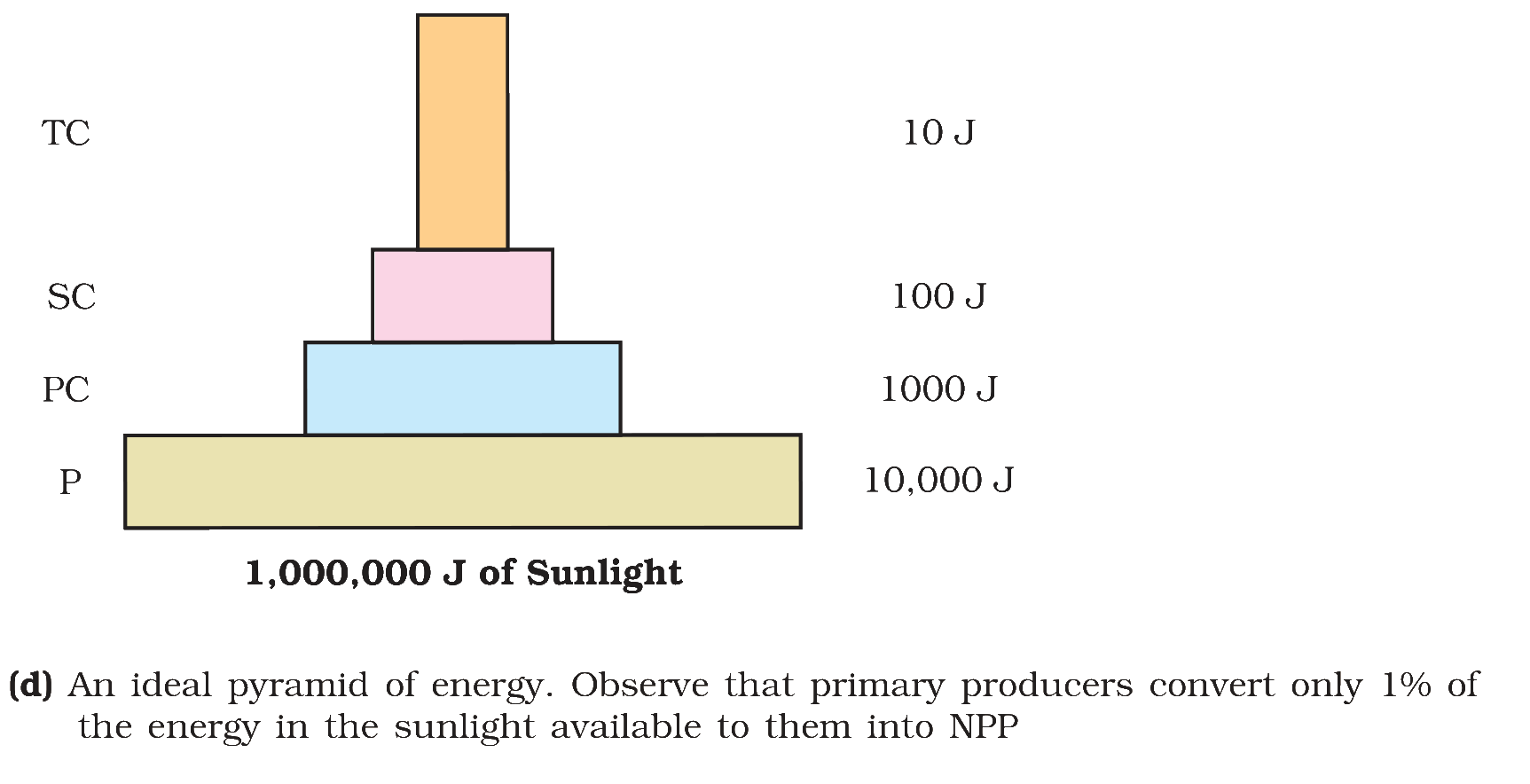
How much energy will be converted by the primary producer to net primary productivity from 20,000 J of available sunlight energy?
Answer & explanation
Correct answer: option 1
The correct answer is Option (1) → 200 J
Net primary productivity (NPP) is the energy that the producers store as new biomass, after their own respiration. Plants capture only a small part of the sunlight that falls on them. NCERT’s ideal pyramid of energy takes this part as 1 per cent.
NPP = 1% of the available sunlight energy
NPP = \( \frac{1}{100} \times 20{,}000 \) J
NPP = 200 J
Option (1) 200 J — Correct. Plants capture only about 1 per cent of the available sunlight energy as net primary productivity. 1% of 20,000 J is 200 J.
Option (2) 2000 J — Incorrect. 2000 J is 10 per cent of the sunlight. The 10 per cent law applies between two trophic levels, such as producers to herbivores, not from sunlight to producers.
Option (3) 10,000 J — Incorrect. 10,000 J is half of the sunlight. Less than half of the sunlight is photosynthetically active radiation (PAR), and plants fix only a small part even of that.
Option (4) 20 kJ — Incorrect. 20 kJ is 20,000 J, the whole of the sunlight. Plants never turn all the sunlight into biomass.
NCERT Extract:
Ecological Pyramids –