
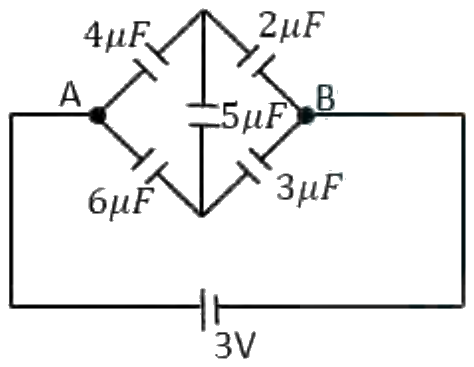
A network of five capacitors is shown in the figure. The total charge stored in the network connected between A and B is:
Answer & explanation
Correct answer: option 2
The correct answer is Option (2) → \( 10\,\mu\mathrm{C} \)
The five capacitors form a bridge. A bridge is balanced when the ratio of the capacitors on one side equals that on the other side. Here
\( \displaystyle \frac{4\,\mu\mathrm{F}}{2\,\mu\mathrm{F}} = \frac{6\,\mu\mathrm{F}}{3\,\mu\mathrm{F}} = 2 \)
so the two middle points are at the same potential, no charge is stored on the \( 5\,\mu\mathrm{F} \) capacitor, and it can be removed. The rest is two series pairs in parallel between A and B.
\( \displaystyle C_{\text{top}} = \frac{4 \times 2}{4 + 2} = \frac{4}{3}\,\mu\mathrm{F} \)
\( \displaystyle C_{\text{bottom}} = \frac{6 \times 3}{6 + 3} = 2\,\mu\mathrm{F} \)
\( \displaystyle C_{AB} = \frac{4}{3} + 2 = \frac{10}{3}\,\mu\mathrm{F} \)
\( \displaystyle Q = C_{AB}\,V = \frac{10}{3}\,\mu\mathrm{F} \times 3\,\mathrm{V} = 10\,\mu\mathrm{C} \)