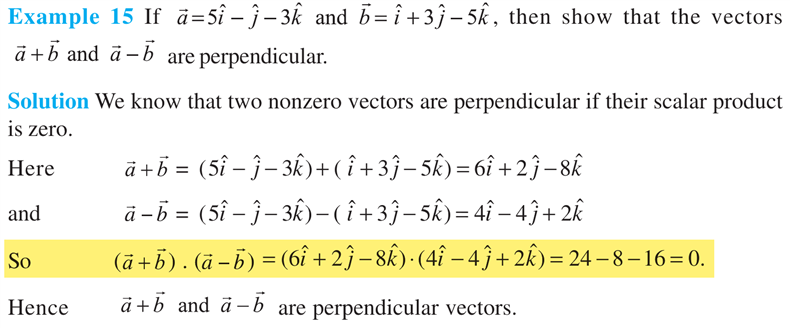
If \( \vec{a}=5\hat{\imath}-\hat{\jmath}-3\hat{k} \) and \( \vec{b}=\hat{\imath}-3\hat{\jmath}-5\hat{k} \) then \( (\vec{a}+\vec{b}).(\vec{a}-\vec{b}) \) is equal to:
Answer & explanation
Correct answer: option 2
The correct answer is Option (2) → 0
On expanding the dot product, the cross terms cancel because \( \vec{a}\cdot\vec{b}=\vec{b}\cdot\vec{a} \).
\( \displaystyle (\vec{a}+\vec{b})\cdot(\vec{a}-\vec{b})=|\vec{a}|^2-|\vec{b}|^2 \)
\( \displaystyle |\vec{a}|^2=25+1+9=35 \)
\( \displaystyle |\vec{b}|^2=1+9+25=35 \)
\( \displaystyle (\vec{a}+\vec{b})\cdot(\vec{a}-\vec{b})=35-35=0 \)
Tip: When the two vectors have the same magnitude, \( \vec{a}+\vec{b} \) and \( \vec{a}-\vec{b} \) are always perpendicular (the diagonals of a rhombus), so the dot product is 0.
NCERT (2026-27 edition):
Product of Two Vectors