
Arrange the following in increasing order of their basic strength in aqueous solution:
(A) \( CH_3NH_2 \)
(B) \( C_6H_5CH_2NH_2 \)
(C) \( C_6H_5NH_2 \)
(D) \( (CH_3)_3N \)
Choose the correct answer from the options given below:
Answer & explanation
Correct answer: option 4
The correct answer is Option (4) → (C), (B), (D), (A)
In water the basic strength of an amine, measured by its \( \mathrm{p}K_b \) (smaller \( \mathrm{p}K_b \), stronger base), depends on three factors together:
the +I effect of alkyl groups, which makes the lone pair more available (favours tertiary > secondary > primary);
solvation of the ammonium ion by hydrogen bonding with water, which stabilises it more when it has more N–H bonds (favours primary > secondary > tertiary);
resonance of the lone pair with a benzene ring, which makes aryl amines much weaker bases.
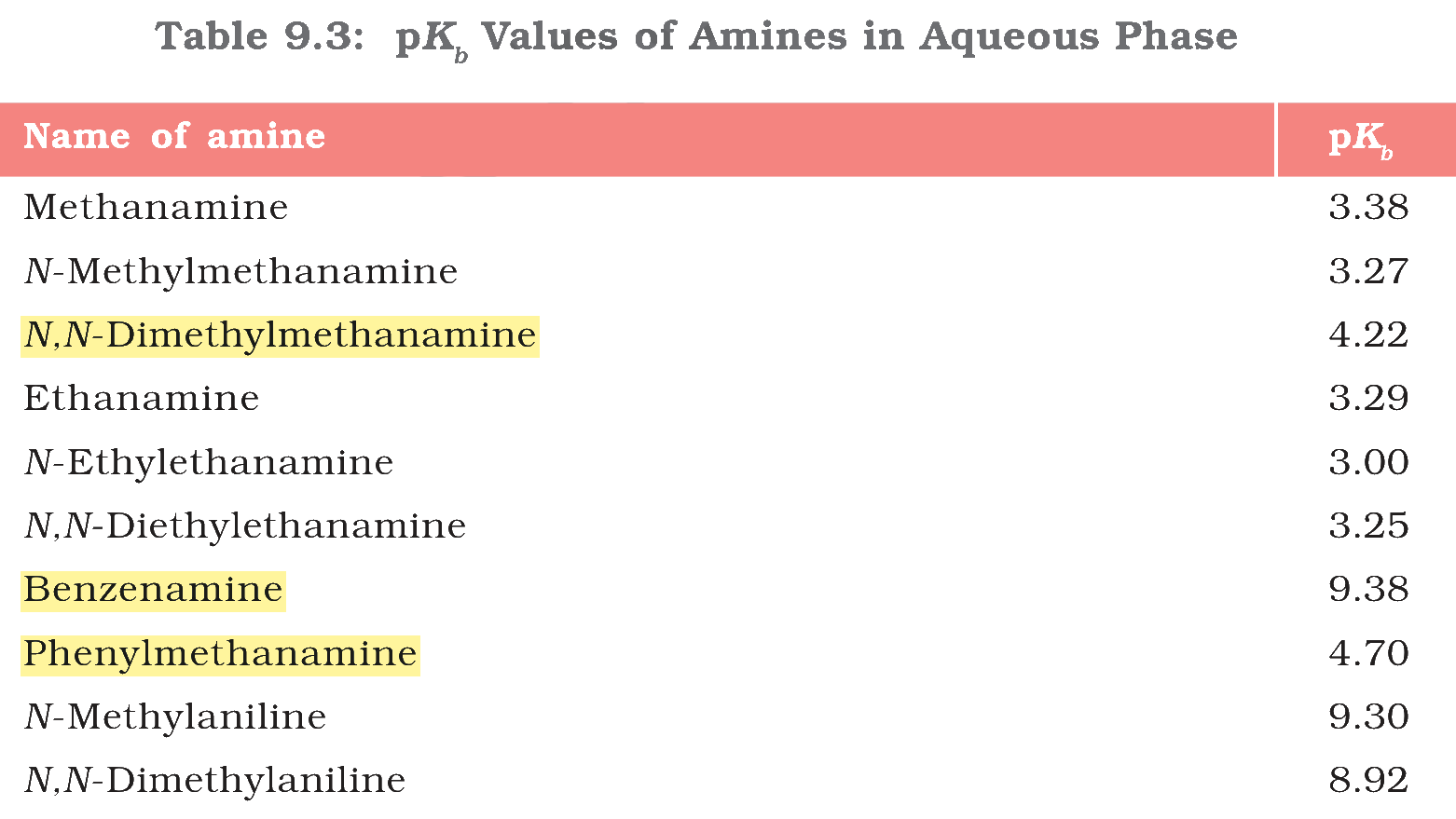
For the methyl amines the combined result is \( \ce{(CH3)2NH} \gt \ce{CH3NH2} \gt \ce{(CH3)3N} \). The given amines:
(A) \( \ce{CH3NH2} \): one methyl group and a well-solvated ion.
(D) \( \ce{(CH3)3N} \): three methyl groups, but its ion has only one N–H bond and is poorly solvated, so it is weaker than methylamine.
(B) \( \ce{C6H5CH2NH2} \): the \( \ce{CH2} \) group keeps the lone pair out of resonance with the ring, but the phenyl group withdraws electrons slightly.
(C) \( \ce{C6H5NH2} \): the lone pair is delocalised into the ring.
Shortcut: Aniline, an aryl amine, is by far the weakest base, so the order starts with (C). Only Option (4) starts with (C).
NCERT (2026-27 edition):
Basic Character of Amines – …
Note: The same/similar question has been asked in different years by NTA as per the details given below:
| 2026 | 2025 | 2024 | 2023 | 2022 |
|---|---|---|---|---|
| – | 30-05 S2 28-05 S2 | – | – | – |