Read the passage carefully and answer the questions based on the passage:
Role of Money
In modern economics, money plays a very crucial role as medium of exchange, unit of account, store of value and standard of deferred payment. The banking system, a cornerstone of financial markets, facilitates the creation and circulation of money.
Commercial banks accept deposits from the public and provide loans. A fraction of the deposits are kept by the commercial banks as reserves and the rest is lent out. This amplifies the money supply in the economy through the 'Multiplier Effect'. The RBI as central Bank regulates the money supply through monetary policy tools. These tools influence the credit availability and overall liquidity in the system, impacting inflation, growth and employment.
If the reserve ratio is 20%, what is the money multiplier?
Answer & explanation
Correct answer: option 1
The correct answer is Option (1) → 5
Given:
Reserve ratio = 20 per cent = 0.2
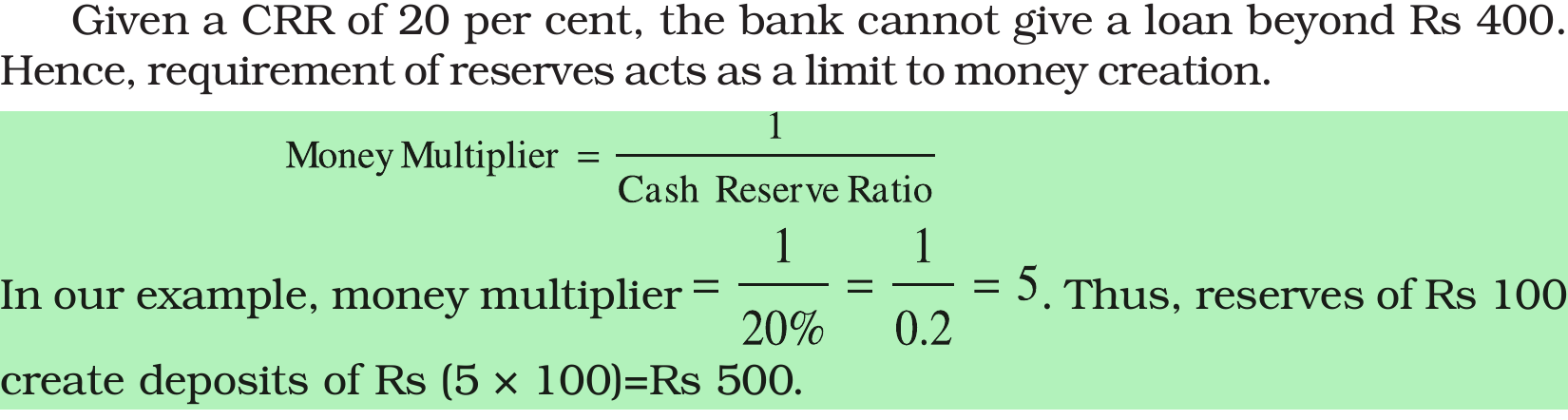
The money multiplier shows how much in deposits each rupee of reserves can support. It is 1 divided by the reserve ratio:
Money multiplier = 1 ÷ reserve ratio
Money multiplier = 1 ÷ 0.2 = 5
So reserves of ₹100 can create deposits of ₹500.
Note: A same/similar question was asked in CUET (UG) in the papers below.
| 2026 | 2025 | 2024 | 2023 | 2022 |
| – | 29-05 S1 | – | 30-05 S1* 20-06 S1* | – |
* A similar question.
NCERT (2026-27): Introductory Macroeconomics — Chapter 3: Money and Banking
|