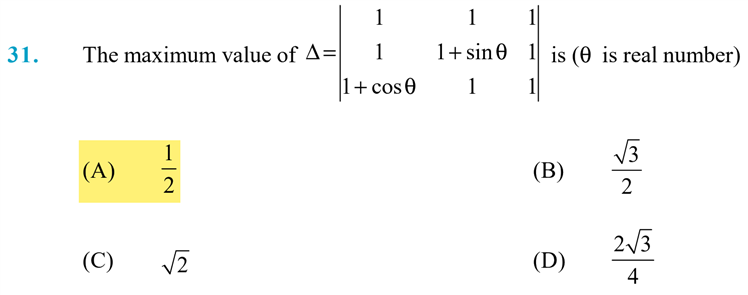
The maximum value of the determinant of the matrix \(\begin{bmatrix}1&1&1\\1&1+\sin x&1\\1+\cos x&1&1\end{bmatrix}\) is:
(where \(x\) is real)
Answer & explanation
Correct answer: option 2
The correct answer is Option (2) → \(\displaystyle\frac{1}{2}\)
Applying \(R_2 \to R_2 - R_1\) and \(R_3 \to R_3 - R_1\) (these row operations do not change the determinant):
\( \displaystyle \Delta = \begin{vmatrix}1&1&1\\0&\sin x&0\\ \cos x&0&0\end{vmatrix}\)
Expanding along \(R_3\), which has only one non-zero entry:
\(\Delta = \cos x\,(1 \cdot 0 - 1 \cdot \sin x)\)
\(= -\sin x\cos x\)
\(\displaystyle \Delta = -\frac{1}{2}\sin 2x\)
Since \(-1 \le \sin 2x \le 1\), the maximum value of \(\Delta\) is \(\frac{1}{2}\), reached when \(\sin 2x = -1\) (for example \(x = \frac{3\pi}{4}\)).
NCERT Exemplar:
Determinants