What is the product of nitration of Benzoic acid?
Answer & explanation
Correct answer: option 2
The correct answer is Option (2) → m-Nitrobenzoic acid
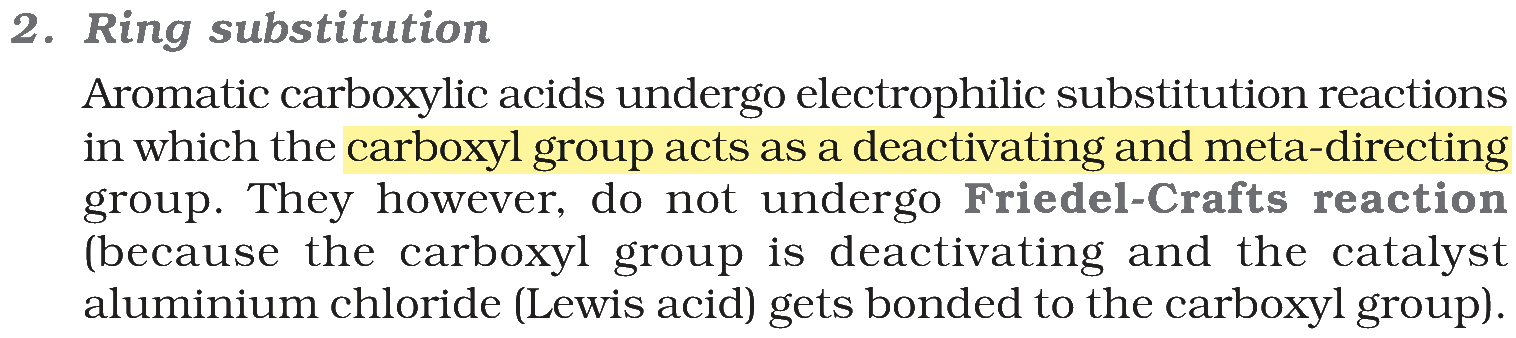
A group already on the benzene ring decides where an electrophile enters. The carboxyl group withdraws electrons from the ring by resonance and induction. Resonance places partial positive charges at the ortho and para positions, so the meta positions are the least electron-poor. The –COOH group is therefore deactivating and meta-directing.
In nitration, the nitrating mixture (concentrated nitric and sulphuric acids) produces the nitronium ion, \( \ce{NO2+} \), which attacks the meta position:
\( \displaystyle \ce{HNO3 + 2H2SO4 -> NO2+ + H3O+ + 2HSO4^-} \)
\( \displaystyle \ce{C6H5COOH + HNO3} \xrightarrow[\text{heat}]{\text{conc. }\ce{H2SO4}} m\text{-}\ce{O2NC6H4COOH + H2O} \)
So the product is m-nitrobenzoic acid (3-nitrobenzoic acid).
Why the other options are incorrect
Option (1) o-Nitrobenzoic acid — Incorrect. The ortho position is one of those made electron-poor by resonance with –COOH, so attack there is disfavoured.
Option (3) o-Nitrobenzoic acid and p-Nitrobenzoic acid — Incorrect. An ortho/para mixture is what an activating group such as –OH or –\( \ce{CH3} \) gives; –COOH is not one.
Option (4) p-Nitrobenzoic acid — Incorrect. The para position is also deactivated by resonance; the para isomer is not the product.
NCERT (2026-27 edition):
Ring Substitution