Consider the following statements:
(A) \(\int_{-a}^{a}f(x)\,dx=2\int_{0}^{a}f(x)\,dx\) if \(f(-x)=-f(x)\)
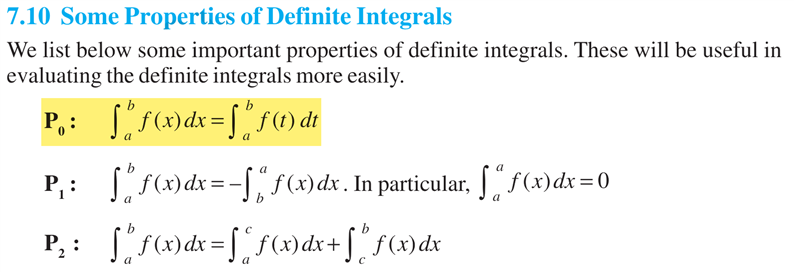
(B) \(\int_{a}^{b}f(x)\,dx=\int_{a}^{b}f(t)\,dt\)
(C) \(\int_{0}^{a}f(x)\,dx=\int_{0}^{a}f(x-a)\,dx\)
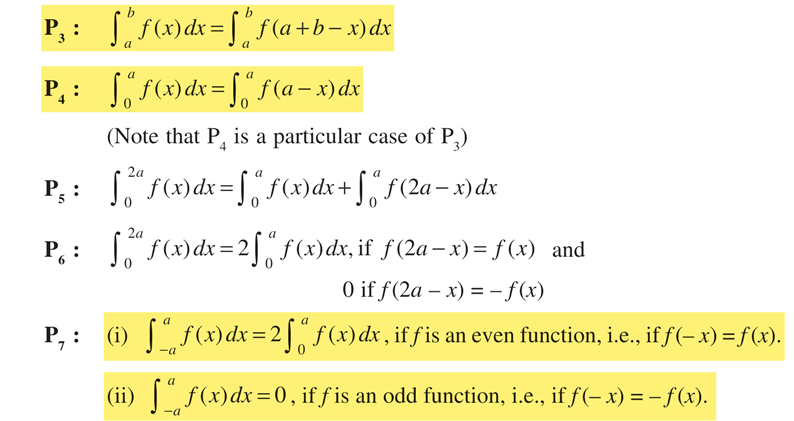
(D) \(\int_{a}^{b}f(x)\,dx=\int_{a}^{b}f(a+b-x)\,dx\)
Choose the correct answer from the options given below:
Answer & explanation
Correct answer: option 4
The correct answer is Option (4) → (B), (D) only
The standard properties of definite integrals needed:
\(\int_{-a}^{a}f(x)\,dx = 0\) when f is odd, that is, \(f(-x)=-f(x)\)
\(\int_{-a}^{a}f(x)\,dx = 2\int_{0}^{a}f(x)\,dx\) when f is even, that is, \(f(-x)=f(x)\)
\(\int_{a}^{b}f(x)\,dx = \int_{a}^{b}f(a+b-x)\,dx\) and \(\int_{0}^{a}f(x)\,dx = \int_{0}^{a}f(a-x)\,dx\)
The letter used for the variable does not change a definite integral, because the value depends only on f, a and b.
So an odd function integrates to 0 over [−a, a], the variable of integration is a dummy, and the reflection property uses f(a − x), not f(x − a).
Checking the statements
(A) \(\int_{-a}^{a}f(x)\,dx=2\int_{0}^{a}f(x)\,dx\) if \(f(-x)=-f(x)\) — Incorrect. For an odd function the integral over [−a, a] is 0; the doubling rule is for even functions.
(B) \(\int_{a}^{b}f(x)\,dx=\int_{a}^{b}f(t)\,dt\) — Correct. Changing the letter x to t does not change the value.
(C) \(\int_{0}^{a}f(x)\,dx=\int_{0}^{a}f(x-a)\,dx\) — Incorrect. Putting t = x − a turns the right side into \(\int_{-a}^{0}f(t)\,dt\), a different interval; the property needs f(a − x).
(D) \(\int_{a}^{b}f(x)\,dx=\int_{a}^{b}f(a+b-x)\,dx\) — Correct. Putting t = a + b − x swaps the limits a and b and the minus sign of dx = −dt swaps them back.
NCERT (2026-27 edition):
Some Properties of Definite Integrals