
E and F are the interior points on the sides BC and CD of a parallelogram ABCD. Let $\vec{B E}= 4 \vec{EC}$ and $\vec{CF}=4 \vec{F D}$. If the line EF meets the diagonal AC in G then $\vec{A G}=\lambda \vec{A C}$ where $\lambda$ is equal to
Answer & explanation
Correct answer: option 4
Let P.V. of A.B. and D be $\vec{0}, \vec{b}, \vec{d}$. Then $\vec{AC}=\vec{b}+\vec{d}$
$\Rightarrow \vec{E}=\frac{\vec{b}+4(\vec{b}+\vec{d})}{5}=\vec{b}+\frac{4}{5} \vec{d}$ and $\vec{F}=\frac{\vec{b}+\vec{d}+4 \vec{d}}{5}=\vec{d}+\frac{1}{5} \vec{b}$
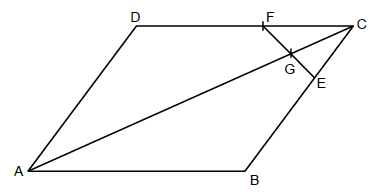
Equation of EF : $\vec{r}=\vec{b}+\frac{4}{5} \vec{d}+\lambda\left(\frac{4}{5} \vec{b}-\frac{1}{5} \vec{d}\right)$
Equation of AC : $\vec{r}=\lambda_1(\vec{b}+\vec{d})$
For point G we must have, $\vec{b}+\frac{4}{5} \vec{d}+\frac{\lambda}{5}(4 \vec{b}-\vec{d})=\lambda_1(\vec{b}+\vec{d})$
$\Rightarrow \lambda_1=\frac{21}{5}, \lambda=-\frac{1}{5} \Rightarrow \vec{AG}=\frac{21}{5} \vec{AC}$
Hence (4) is correct answer.