The reaction of toluene with chlorine in the presence of ferric chloride gives predominantly
Answer & explanation
Correct answer: option 4
The correct answer is Option (4) → o- and p-Chlorotoluene
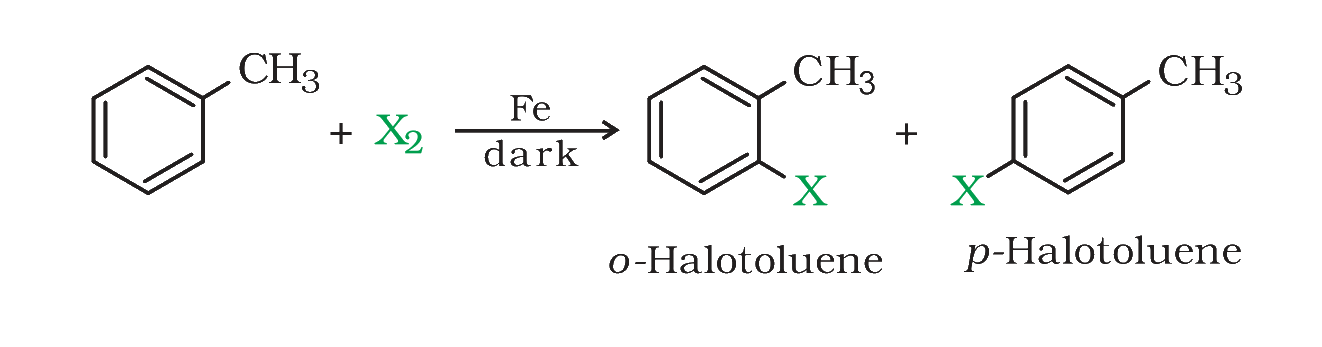
Ferric chloride is a Lewis acid catalyst. With it, chlorine attacks the benzene ring by electrophilic substitution, and a ring hydrogen is replaced by Cl. In toluene the new Cl goes to the positions ortho and para to the \( \ce{CH3} \) group:
\( \displaystyle \ce{C6H5CH3 + Cl2} \xrightarrow[\text{dark}]{\ce{FeCl3}} \ce{ClC6H4CH3} \text{ (}o\text{- and }p\text{-)} + \ce{HCl} \)
Why the other options are incorrect
Option (1) Benzoyl chloride — Incorrect. Benzoyl chloride, \( \ce{C6H5COCl} \), is an acid chloride with a C=O group; chlorination brings in no oxygen.
Option (2) m-Chlorotoluene — Incorrect. The substitution takes place at the ortho and para positions, not the meta position.
Option (3) Benzyl chloride — Incorrect. In benzyl chloride, \( \ce{C6H5CH2Cl} \), the Cl is on the side chain (the \( \ce{CH3} \) group). With a Lewis acid catalyst the reaction is electrophilic substitution of the aromatic ring, so a ring hydrogen is replaced instead.
NCERT (2026-27 edition):
6.5 Preparation of Haloarenes: (i) From hydrocarbons by electrophilic substitution – “Aryl chlorides and bromides can be easily prepared by electrophilic substitution of arenes with chlorine and bromine respectively in the presence of Lewis acid catalysts like iron or iron(III) chloride.”