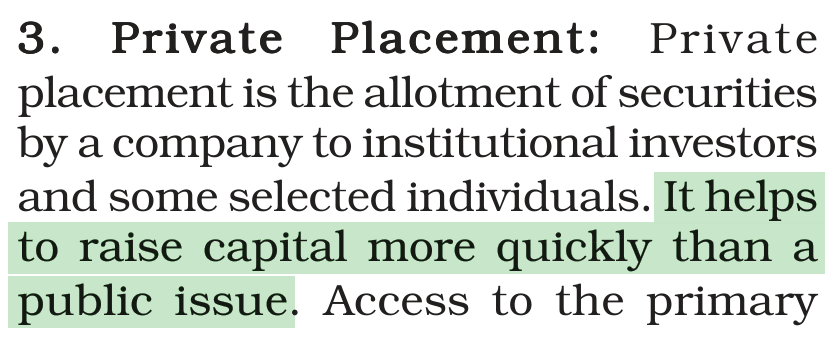
Which method of floatation helps a company to raise capital more quickly than a public issue, and is used by companies that cannot afford a public issue?
Answer & explanation
Correct answer: option 2
The correct answer is Option (2) → Private placement
Option (1) Offer for sale — Incorrect. Here the company sells securities en bloc at an agreed price to brokers, who resell them to the investing public. The securities still reach the investing public through these brokers, so it is a route to the public.
Option (2) Private placement — Correct. Private placement is the allotment of securities to institutional investors and some selected individuals. It skips a public issue, so it raises capital more quickly. A public issue has heavy expenses, so companies that cannot afford one choose this method.
Option (3) Rights issue — Incorrect. A rights issue is a privilege of existing shareholders. They may buy new shares in proportion to the shares they already hold. It goes only to present shareholders.
Option (4) e-IPOs — Incorrect. An e-IPO is an issue of capital to the public through the on-line system of the stock exchange. It is itself a public issue, so it does not help a company that cannot afford one.
NCERT (Pre-rationalised Edition):
NCERT (Pre-rationalised Edition): “… Access to the primary market can be expensive on account of various mandatory and non-mandatory expenses. Some companies, therefore, cannot afford a public issue and choose to use private placement.” |