
Match Column I with Column II.
| Column I | Column II |
| A. Antipodals | 1. 3n |
| B. Central cell | 2. 2n |
| C. MMC | 3. (n + n) |
| D. Endosperm | 4. n |
Answer & explanation
Correct answer: option 4
The correct answer is Option (4) → A - 4, B - 3, C - 2, D - 1
(A) Antipodals — this matches (4) n. The embryo sac forms from a haploid megaspore by mitosis, so its cells, including the three antipodals at the chalazal end, are haploid.
(B) Central cell — this matches (3) (n + n). The large central cell holds two haploid polar nuclei, so it is written n + n.
(C) MMC — this matches (2) 2n. The megaspore mother cell is a cell of the ovule that undergoes meiosis, so it is diploid; meiosis makes the haploid megaspores.
(D) Endosperm — this matches (1) 3n. A male gamete fuses with the two polar nuclei (triple fusion) to give the triploid primary endosperm nucleus, which forms the endosperm.
NCERT Extract:
The Pistil, Megasporangium (Ovule) and Embryo Sac – “… The MMC undergoes meiotic division. … Three cells are at the chalazal end and are called the antipodals. The large central cell, as mentioned earlier, has two polar nuclei. Thus, a typical angiosperm embryo sac, at maturity, though 8-nucleate is 7-celled.”
Double Fertilisation – “… The other male gamete moves towards the two polar nuclei located in the central cell and fuses with them to produce a triploid primary endosperm nucleus (PEN) (Figure 1.13a). As this involves the fusion of three haploid nuclei it is termed triple fusion. … The central cell after triple fusion becomes the primary endosperm cell (PEC) and develops into the endosperm while the zygote develops into an embryo.”
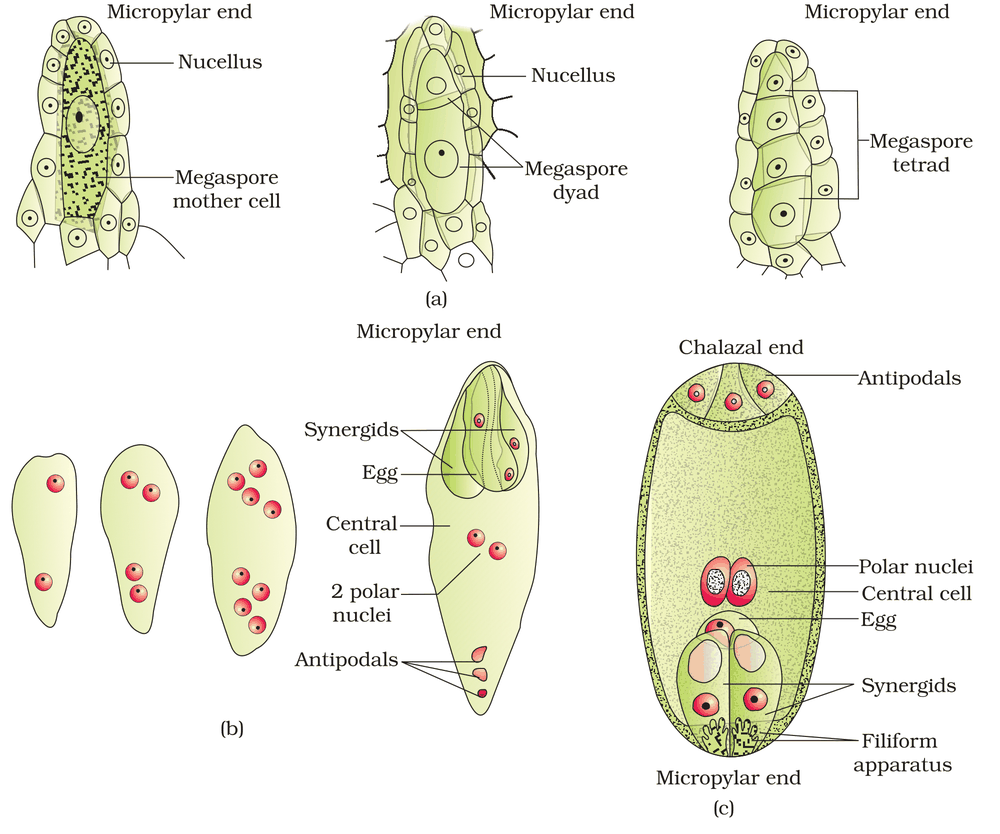
Figure 1.8 (a) Parts of the ovule showing a large megaspore mother cell, a dyad and a tetrad of megaspores; (b) 2, 4, and 8-nucleate stages of embryo sac and a mature embryo sac; (c) A diagrammatic representation of the mature embryo sac