
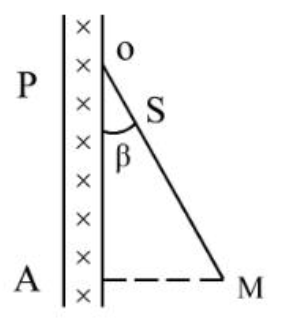
A charged ball 'M' hangs from a silk thread 'S' which makes an angle β, with a large charged conducting sheet 'P' as shown. The surface charge density σ of the sheet is proportional to
Answer & explanation
Correct answer: option 1
The correct answer is Option (1) → tan B
The ball is in equilibrium under three forces: its weight \( mg \) downward, the electric force \( qE \) away from the sheet (horizontal) and the tension \( T \) along the thread. The options write the angle \( \beta \) as B.
The field near a large charged conducting sheet is uniform and perpendicular to it:
\( \displaystyle E = \frac{\sigma}{\varepsilon_0} \)
Resolving the tension along the vertical (the sheet) and the horizontal:
\( T\cos\beta = mg \)
\( T\sin\beta = qE \)
Dividing the second equation by the first:
\( \displaystyle \tan\beta = \frac{qE}{mg} = \frac{q\,\sigma}{\varepsilon_0\,mg} \)
\( \displaystyle \sigma = \frac{\varepsilon_0\,mg}{q}\,\tan\beta \;\Rightarrow\; \sigma \propto \tan\beta \)
Since \( m \), \( g \) and \( q \) are fixed, the surface charge density is proportional to tan β. The same result holds for a non-conducting sheet, where \( E = \sigma/2\varepsilon_0 \); only the constant changes.