For a given photosensitive material and frequency of incident radiation,
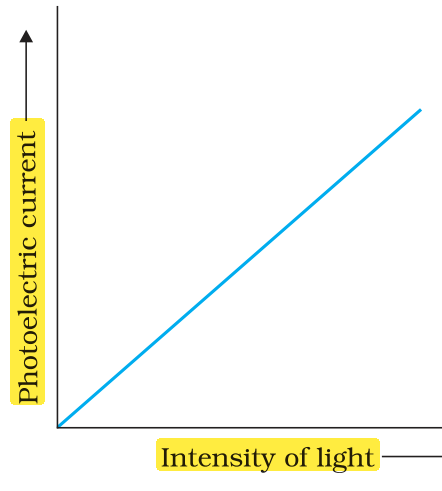
A. above the threshold frequency, the photoelectric current is directly proportional to the intensity of the incident radiation.
B. the photoelectric emission process has observable time lag especially when the incident radiation is made exceedingly dim.
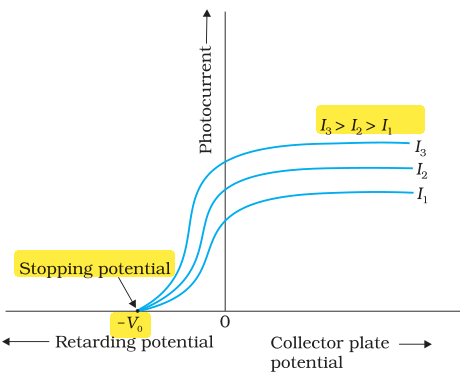
C. the stopping potential is independent of the intensity of the incident radiation.
D. below the threshold frequency, the emission of photo-electrons takes place instantly.
Choose the correct answer from the options given below:
Answer & explanation
Correct answer: option 2
The correct answer is Option (2) → A and C only
In the photon picture, each photon gives all its energy \( h\nu \) to a single electron. Intensity decides how many photons arrive per second; frequency decides the energy each electron receives.
(A) above the threshold frequency, the photoelectric current is directly proportional to the intensity of the incident radiation. — Correct. More photons per second eject more electrons, so the photocurrent rises in proportion.
(B) the photoelectric emission process has observable time lag especially when the incident radiation is made exceedingly dim. — Incorrect. Emission is instantaneous even for very dim light, since an electron absorbs a whole photon at once.
(C) the stopping potential is independent of the intensity of the incident radiation. — Correct. \( eV_0 = h\nu - \phi_0 \) depends only on the frequency and the work function.
(D) below the threshold frequency, the emission of photo-electrons takes place instantly. — Incorrect. Below the threshold frequency no photoelectrons are emitted at all, however intense the light.
NCERT (2026-27):
Effect of Frequency of Incident Radiation on Stopping Potential – …