Arrange the following alternative measures of money supply in decreasing order of liquidity.
Where CU= Currency and DD = Demand Deposit
A. CU + DD
B. CU + DD + Net time deposits of commercial banks
C. CU + DD + Savings deposits with Post Office savings banks
D. CU +DD + Net time deposits of commercial banks +Total deposits with Post Office savings organizations (excluding NSC)
Choose the correct sequence from the options given below:
Answer & explanation
Correct answer: option 2
The correct answer is Option (2) → A, C, B, D
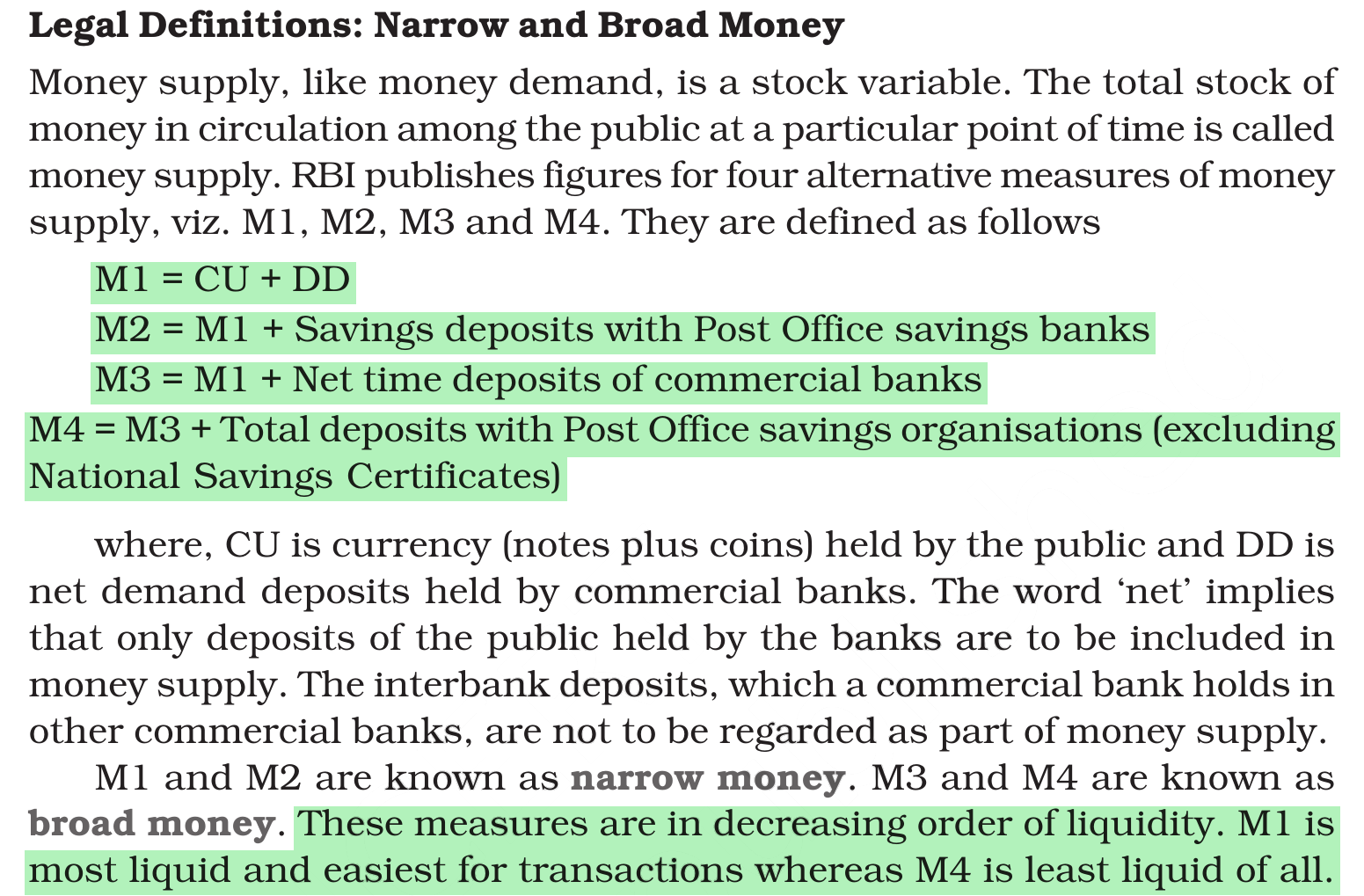
An asset’s liquidity is the ease with which it can be used for transactions: currency and demand deposits can be spent at once, while savings and time deposits take longer to turn into spending. Each measure of money supply adds a less liquid asset to the one before, so M1 is the most liquid and M4 the least.
A. CU + DD — this is M1: currency held by the public plus net demand deposits held by commercial banks. Both can be spent at once, so this is the most liquid measure; M1 and M2 are called narrow money.
C. CU + DD + Savings deposits with Post Office savings banks — this is M2, M1 plus savings deposits with post office savings banks. These deposits are not as freely usable for payments as currency and demand deposits.
B. CU + DD + Net time deposits of commercial banks — this is M3, M1 plus net time deposits of commercial banks. Time deposits are held for a fixed period, so they are less liquid again; M3 is called broad money.
D. CU +DD + Net time deposits of commercial banks +Total deposits with Post Office savings organizations (excluding NSC) — this is M4, M3 plus total deposits with post office savings organisations (excluding National Savings Certificates). It includes every deposit of the earlier measures and more, so it is the least liquid.
Note: A same/similar question was asked in CUET (UG) in the papers below.
| 2026 | 2025 | 2024 | 2023 | 2022 |
| 12-05 S1* 19-05 S2 07-06 S2* | 13-05 S2* | – | – | – |
* A similar question.
NCERT: Introductory Macroeconomics — Chapter 3: Money and Banking (2025-26)
|