Read the passage and answer the questions:
Classification of Land under Akbar
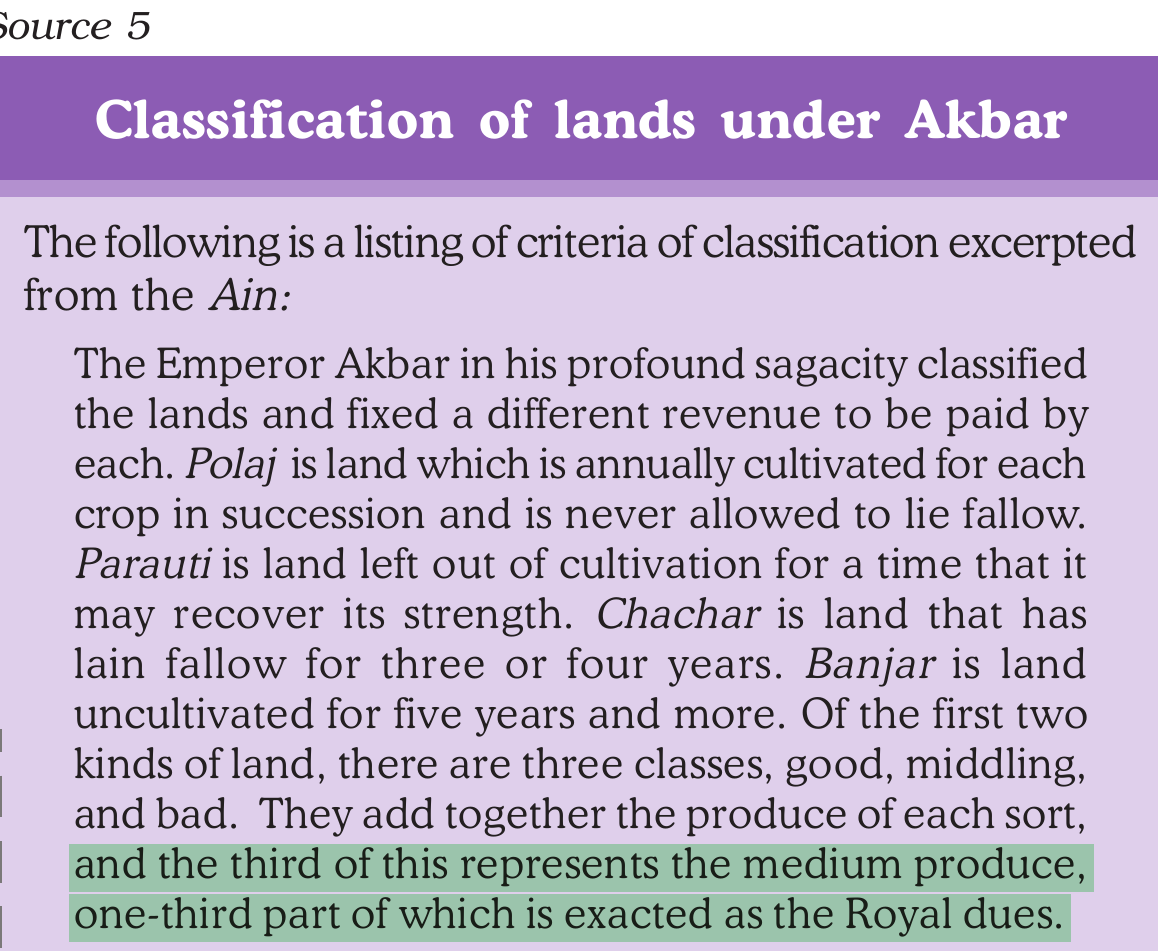
The following is a listing of criteria of classification excerpted from the Ain: The Emperor Akbar in his profound sagacity classified the lands and fixed a different revenue to be paid by each. Polaj is land which is annually cultivated for each crop in succession and is never allowed to lie fallow. Parauti is land left out of cultivation for a time that it may recover its strength. Chachar is land that has lain fallow for three or four years. Banjar is land uncultivated for five years and more. Of the first two kinds of land, there are three classes, good, middling, and bad. They add together the produce of each sort, and the third of this represents the medium produce, one-third part of which is exacted as the Royal dues. Revenue from the land was the economic mainstay of the Mughal Empire. It was therefore vital for the state to create an administrative apparatus to ensure control over agricultural production, and to fix and collect revenue from across the length and breadth of the rapidly expanding empire. This apparatus included the office (daftar)…, responsible for supervising the fiscal system of the empire. Thus revenue officials and record keepers penetrated the agricultural domain and became a decisive agent in shaping agrarian relations.
What proportion of produce was exacted by the state as royal dues?
Answer & explanation
Correct answer: option 3
The correct answer is Option (3) → One-third part
Polaj and parauti lands were each divided into three classes: good, middling and bad. The produce of the three was added together, and one-third of this total was taken as the medium produce. Of this medium produce, one-third part was exacted as the Royal dues.
NCERT: Themes in Indian History Part II — Chapter 8: Peasants, Zamindars and the State (2025-26)
|