Arrange the following money measures into their high to low liquid form.
(A) M4
(B) M2
(C) M1
(D) M3
Choose the correct answer from the options given below:
Answer & explanation
Correct answer: option 4
The correct answer is Option (4) → (C), (B), (D), (A)
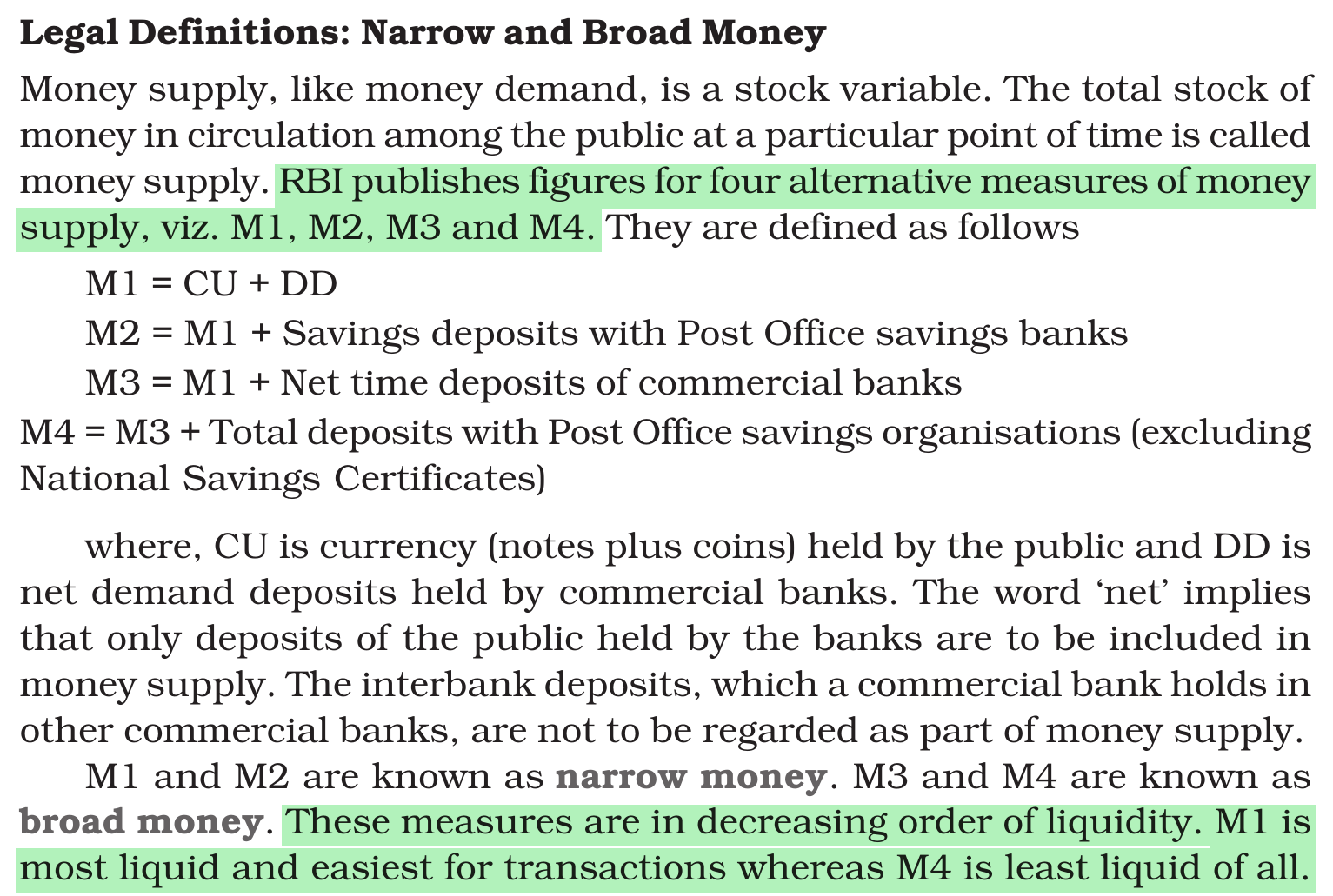
The more easily money can be used for transactions, the higher its liquidity. The four measures are in decreasing order of liquidity, from M1 to M4, so M1 is the most liquid and M4 the least.
(C) M1 — Currency held by the public plus net demand deposits held by commercial banks. It is the easiest for transactions. Demand deposits are payable by the bank on demand. M1 and M2 are known as narrow money.
(B) M2 — M1 plus savings deposits with Post Office savings banks.
(D) M3 — M1 plus net time deposits of commercial banks. Time deposits are held for a fixed period. M3 and M4 are known as broad money.
(A) M4 — M3 plus total deposits with Post Office savings organisations, leaving out National Savings Certificates.
Note: A same/similar question was asked in CUET (UG) in the papers below.
| 2026 | 2025 | 2024 | 2023 | 2022 |
| 12-05 S1* 19-05 S2* 07-06 S2* | 13-05 S2 | – | – | – |
* A similar question.
NCERT (2026-27): Introductory Macroeconomics — Chapter 3: Money and Banking
|