The reaction which can be used to prepare aryl halides is
Answer & explanation
Correct answer: option 3
The correct answer is Option (3) → Sandmeyer's reaction
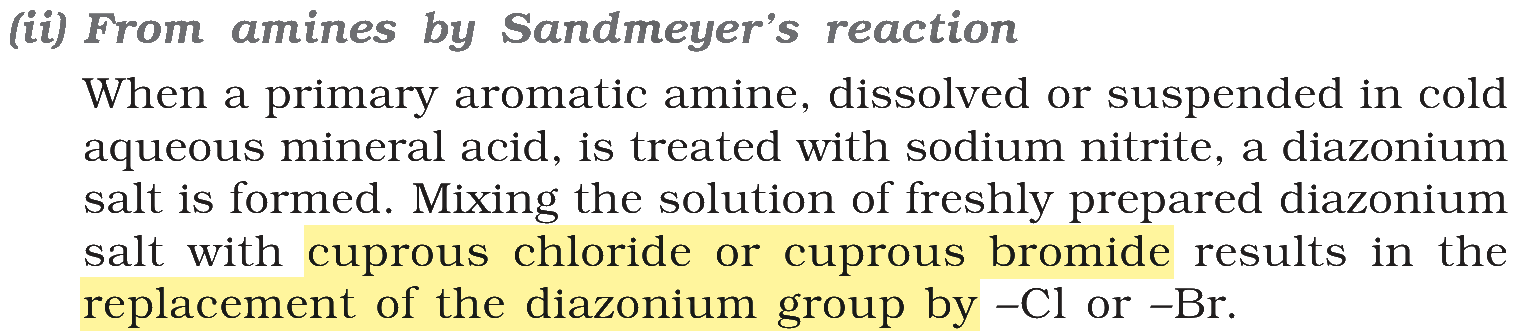
Aryl halides cannot be made from phenols the way alkyl halides are made from alcohols, because the C–O bond of phenol is too strong to break. They are made instead from primary aromatic amines through diazonium salts. The amine is first diazotised with sodium nitrite and hydrochloric acid in the cold:
\( \displaystyle \ce{C6H5NH2 + NaNO2 + 2HCl} \xrightarrow{\text{273-278 K}} \ce{C6H5N2+Cl^- + NaCl + 2H2O} \)
The diazonium salt is then warmed with cuprous chloride or cuprous bromide, and the diazonium group is replaced by –Cl or –Br, with loss of nitrogen gas. This is the Sandmeyer reaction:
\( \displaystyle \ce{C6H5N2+Cl^-} \xrightarrow{\ce{CuCl/HCl}} \ce{C6H5Cl + N2} \)
\( \displaystyle \ce{C6H5N2+Cl^-} \xrightarrow{\ce{CuBr/HBr}} \ce{C6H5Br + N2} \)
So the reaction used to prepare aryl halides is Sandmeyer's reaction.
Why the other options are incorrect
Option (1) Aldol reaction — Incorrect. An aldehyde or ketone with an α-hydrogen adds to another molecule in dilute alkali to give a β-hydroxy carbonyl compound, \( \ce{2CH3CHO -> CH3CH(OH)CH2CHO} \); no halogen is introduced.
Option (2) Kolbe's reaction — Incorrect. Sodium phenoxide is heated with carbon dioxide under pressure and then acidified to give salicylic acid (2-hydroxybenzoic acid); it makes an acid, not a halide:
\( \displaystyle \ce{C6H5ONa} \xrightarrow[\text{(ii) }\ce{H+}]{\text{(i) }\ce{CO2},\ \text{400 K, 4-7 atm}} o\text{-}\ce{HOC6H4COOH} \)
Option (4) Reimer-Tiemann reaction — Incorrect. Phenol is treated with chloroform and sodium hydroxide to give salicylaldehyde; the chlorine of \( \ce{CHCl3} \) is lost, and the product has a –CHO group, not a halogen:
\( \displaystyle \ce{C6H5OH} \xrightarrow[\text{(ii) }\ce{H+}]{\text{(i) }\ce{CHCl3},\ \text{aq. }\ce{NaOH}} o\text{-}\ce{HOC6H4CHO} \)
NCERT (2026-27 edition):
From Amines by Sandmeyer’s Reaction