
What is the total number of stereoisomers possible for the following two coordination entities taken together?
(i) \( \ce{[Co(en)3]^3+} \), where en is ethane-1,2-diamine
(ii) \( \ce{[Pt(NH3)(H2O)Cl2]} \), a square planar complex
Answer & explanation
Correct answer: option 2
The correct answer is Option (2) → 4
Stereoisomers have the same formula and the same bonds but a different arrangement in space. They are of two kinds: geometrical and optical isomers. Count the forms of each entity and add them.
(i) \( \ce{[Co(en)3]^3+} \) — an octahedral entity with three didentate en ligands. It exists as two mirror images that cannot be superimposed, the d and l forms: 2 optical isomers.
(ii) \( \ce{[Pt(NH3)(H2O)Cl2]} \) — a square planar complex of the type [MX2LL′]. The two Cl ligands are either adjacent to each other (cis) or opposite to each other (trans): 2 geometrical isomers.
Total = 2 + 2 = 4.
NCERT (2026-27 edition):
5.4.2 Optical Isomerism – “Optical isomers are mirror images that cannot be superimposed on one another. … The two forms are called dextro (d) and laevo (l) … Optical isomerism is common in octahedral complexes involving didentate ligands (Fig. 5.6).”
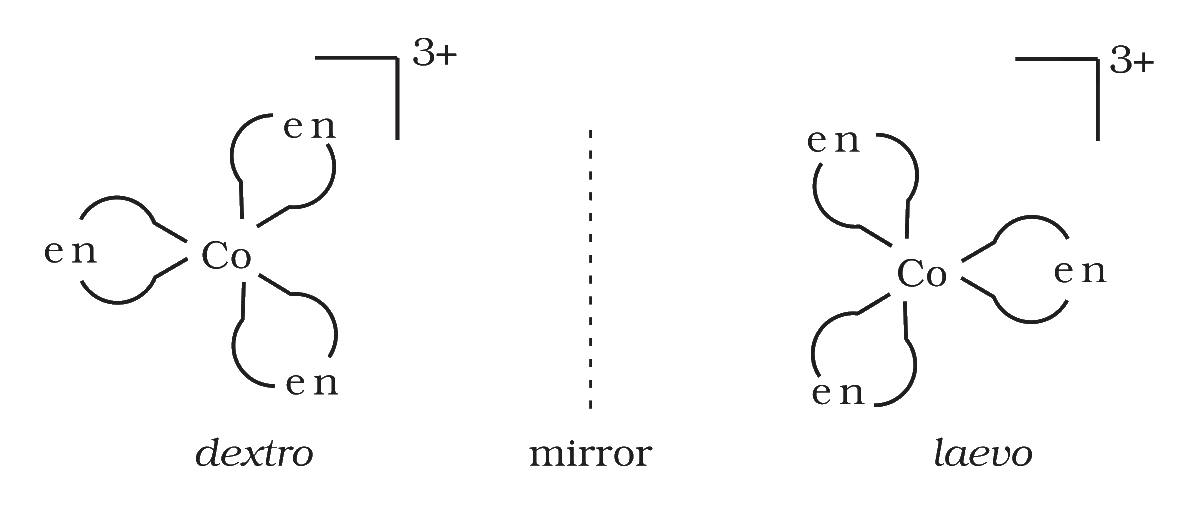
Fig. 5.6: Optical isomers (d and l) of [Co(en)3]3+
Intext Question 5.3 – “Indicate the types of isomerism exhibited by the following complexes and draw the structures for these isomers: … (ii) [Co(en)3]Cl3 … (iv) [Pt(NH3)(H2O)Cl2]”
Answers to Some Intext Questions – “5.3 … (ii) Two optical isomers can exist. … (iv) Geometrical (cis-, trans-) isomers can exist.”