
If G is the intersection of diagonals of a parallelogram ABCD and O is any point, then $\vec{OA}+\vec{OB}+\vec{OC}+\vec{OD}=$
Answer & explanation
Correct answer: option 2
Taking O as the origin, let the position vectors of A, B, C and D be $\vec a,\vec b,\vec c$ and $\vec d$ respectively.
In ΔOAC, G is the mid-point of AC.
$∴\vec{OA}+\vec{OC}=2\vec{OG}$ ...(i)
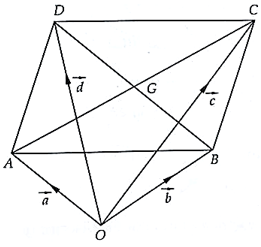
In ΔOBD, G is the mid-point of BC.
$∴\vec{OB}+\vec{OD}=2\vec{OG}$ ...(ii)
Adding (i) and (ii), we get
$\vec{OA}+\vec{OB}+\vec{OC}+\vec{OD}=4\vec{OG}$