
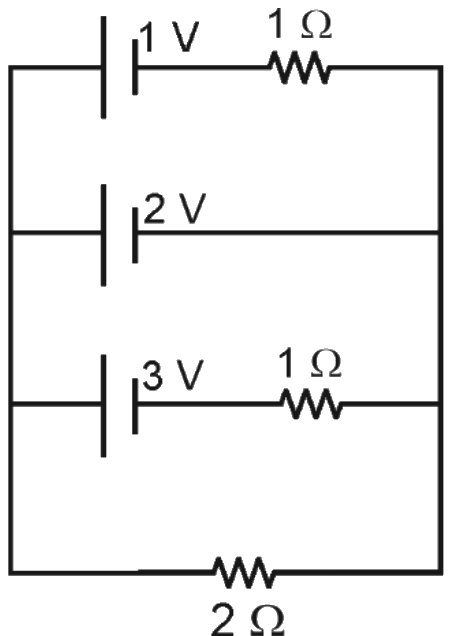
Current through 1V cell and through 2 Ω resistor respectively is
Answer & explanation
Correct answer: option 4
The correct answer is Option (4) → 1A, 1A
All four branches are connected in parallel between the same two junctions. The 2 V cell has no resistance in its branch, so it fixes the potential difference between the junctions at 2 V. In every cell the longer plate (positive terminal) is on the left, so the left junction is 2 V above the right junction.
Take the right junction at 0 V; the left junction is then at 2 V.
In the 1 V branch, going from the left junction through the cell (from its positive to its negative terminal) the potential drops by 1 V, so the end of the \( 1\,\Omega \) resistor next to the cell is at
\( \displaystyle V = 2 - 1 = 1\,\mathrm{V} \)
The current through the \( 1\,\Omega \) resistor, and so through the 1 V cell, is
\( \displaystyle I_{1} = \frac{1 - 0}{1\,\Omega} = 1\,\mathrm{A} \)
The \( 2\,\Omega \) resistor has the full 2 V across it:
\( \displaystyle I_{2} = \frac{2\,\mathrm{V}}{2\,\Omega} = 1\,\mathrm{A} \)
So the currents are 1 A and 1 A.