Which of the following statements are correct?
A. p-nitrophenol is more acidic than m-nitrophenol.
B. Greater the pKa value, weaker is the acid.
C. Tertiary alcohols are more acidic than primary alcohols.
D. Phenol is more acidic than cresols.
Answer & explanation
Correct answer: option 4
The correct answer is Option (4) → A, B and D only
An acid is stronger when the anion left after losing H+ is more stable. Its strength is measured by Ka, or more conveniently by pKa = −log Ka:
Electron withdrawing groups (–\( \ce{NO2} \)) stabilise the phenoxide or alkoxide ion and increase acidity; the effect is strongest at the ortho and para positions, where resonance also acts.
Electron releasing groups (–\( \ce{CH3} \), alkyl groups) put more negative charge on oxygen and decrease acidity.
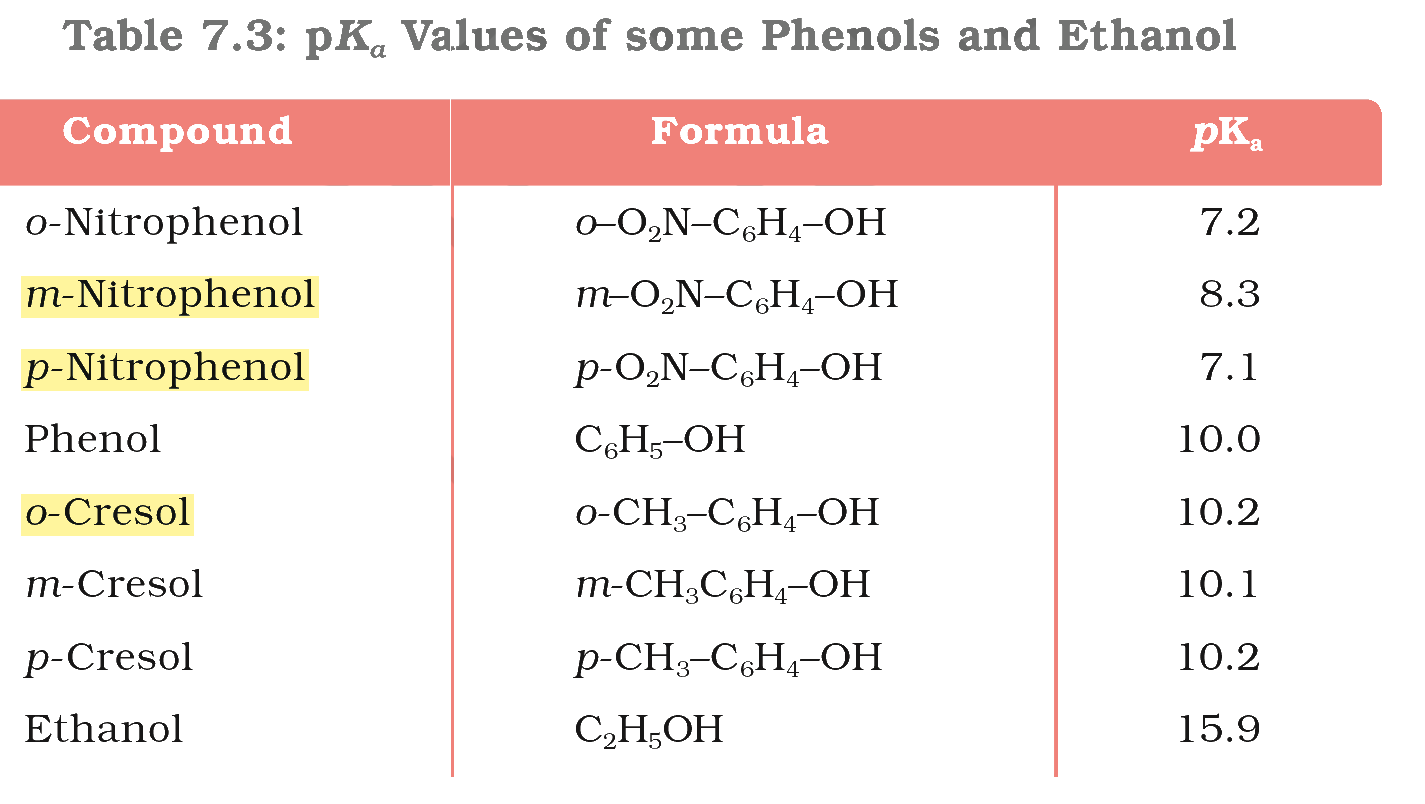
A. p-nitrophenol is more acidic than m-nitrophenol. — Correct. At the para position the –\( \ce{NO2} \) group withdraws electrons by resonance and inductive effect and spreads the negative charge onto its own oxygen atoms. At meta only the weaker inductive effect acts. pKa: p-nitrophenol 7.1, m-nitrophenol 8.3.
B. Greater the pKa value, weaker is the acid. — Correct. A larger pKa means a smaller Ka, so the acid ionises less.
C. Tertiary alcohols are more acidic than primary alcohols. — Incorrect. Alkyl groups release electrons (+I effect) and destabilise the alkoxide ion. A tertiary alcohol has three alkyl groups on the carbon bearing –OH, so the order of acidity is 1° > 2° > 3°.
D. Phenol is more acidic than cresols. — Correct. Cresols (methylphenols) carry an electron releasing –\( \ce{CH3} \) group, which destabilises the phenoxide ion. pKa: phenol 10.0, o-cresol 10.2.
NCERT (2026-27 edition):
Acidity of Alcohols – “… An electron-releasing group (–CH3, –C2H5) increases electron density on oxygen tending to decrease the polarity of O-H bond. This decreases the acid strength. …”
Acidity of Phenols – “… The greater the pKa value, the weaker the acid.”