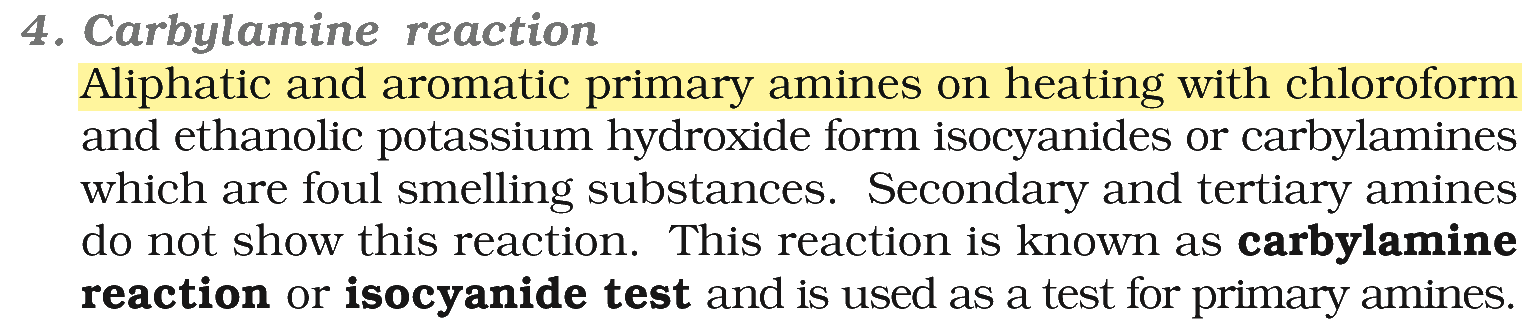
Aliphatic and aromatic primary amines on heating with chloroform and ethanolic KOH form isocyanides. Identify the name of the reaction.
Answer & explanation
Correct answer: option 3
The correct answer is Option (3) → Carbylamine reaction
The carbylamine reaction (isocyanide test) is the test for primary amines: aliphatic and aromatic primary amines heated with chloroform and ethanolic KOH give isocyanides, which have a very unpleasant smell. Secondary and tertiary amines do not give it.
\( \ce{R-NH2 + CHCl3 + 3KOH} \xrightarrow{\text{heat}} \ce{R-NC + 3KCl + 3H2O} \)
Option (1) Gabriel Phthalimide reaction — Incorrect. A method of preparing primary aliphatic amines: phthalimide is treated with KOH, the potassium salt is alkylated, and hydrolysis releases the amine.
\( \text{Phthalimide} \xrightarrow{\ce{KOH}} \text{N-K salt} \xrightarrow{\ce{RX}} \text{N-alkylphthalimide} \xrightarrow{\ce{NaOH(aq)}} \ce{R-NH2} \)
Option (2) Hoffmann bromamide degradation reaction — Incorrect. Converts an amide into a primary amine with one carbon atom less.
\( \ce{RCONH2 + Br2 + 4NaOH -> RNH2 + Na2CO3 + 2NaBr + 2H2O} \)
Option (4) Sandmeyer reaction — Incorrect. Replaces the diazonium group of an arenediazonium salt by Cl, Br or CN using Cu(I) salts.
\( \ce{ArN2+X^-} \xrightarrow{\ce{CuCl/HCl}} \ce{ArCl + N2} \)
NCERT (2026-27 edition):
Carbylamine Reaction