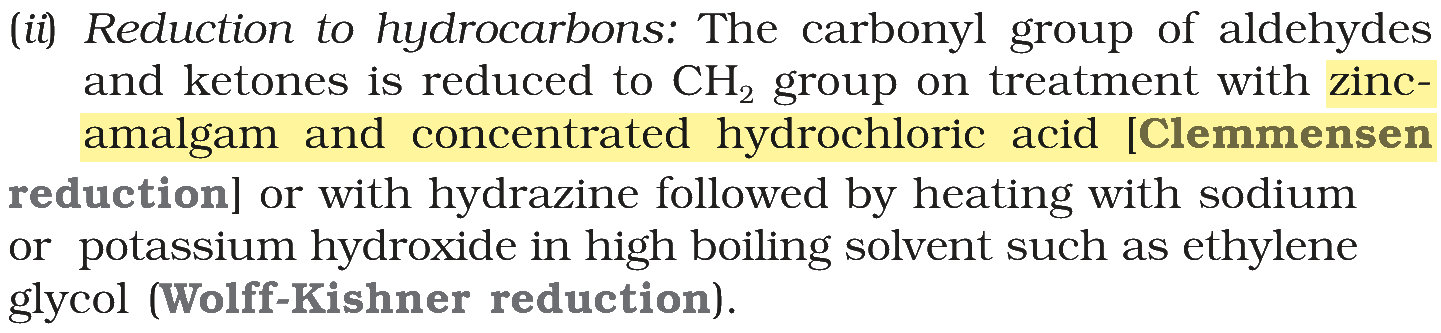
What is the reagent used in Clemmensen reduction?
Answer & explanation
Correct answer: option 3
The correct answer is Option (3) → \(Zn-Hg/conc.\, HCl\)
In the Clemmensen reduction the carbonyl group of an aldehyde or ketone is reduced to a CH2 group by zinc amalgam and concentrated hydrochloric acid:
\( \displaystyle \ce{R2C=O} \xrightarrow{\ce{Zn-Hg},\ \text{conc. }\ce{HCl}} \ce{R2CH2 + H2O} \)
For example, acetone gives propane:
\( \displaystyle \ce{CH3COCH3} \xrightarrow{\ce{Zn-Hg},\ \text{conc. }\ce{HCl}} \ce{CH3CH2CH3 + H2O} \)
The reaction is done in acid, so it suits carbonyl compounds that are stable to acid. The reagent is Zn-Hg / conc. HCl.
Why the other options are incorrect
Option (1) \(NH_2NH_2\) — Incorrect. Hydrazine is the reagent of the Wolff-Kishner reduction, the basic counterpart: the hydrazone is heated with KOH in ethylene glycol, \( \ce{R2C=O} \xrightarrow[\ce{KOH},\ \text{heat}]{\ce{NH2NH2}} \ce{R2CH2 + N2} \).
Option (2) \(NaOCl\) — Incorrect. Sodium hypochlorite is an oxidising agent; with methyl ketones it gives the haloform reaction, not a reduction:
\( \displaystyle \ce{R-CO-CH3 + 3NaOCl -> R-COONa + CHCl3 + 2NaOH} \)
Option (4) \(NaHSO_3\) — Incorrect. Sodium hydrogensulphite adds to the carbonyl group to form a crystalline bisulphite addition compound, used to separate and purify aldehydes; the C=O is not reduced to \( \ce{CH2} \):
\( \displaystyle \ce{R-CHO + NaHSO3 -> R-CH(OH)SO3Na} \)
NCERT (2026-27 edition):
Reduction to Hydrocarbons