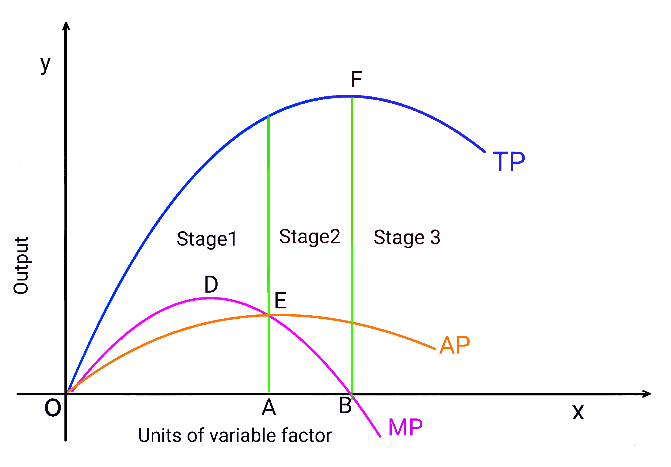
Assertion: Marginal Product of an input can be positive, zero and negative.
Reasoning: Average Product of an input can be positive or undefined but can never be negative.
Answer & explanation
Correct answer: option 2
The correct answer is Option 2: Both Assertion (A) and reasoning (R) are correct and but R is not the correct explanation of A.
Explanation
Assertion (A): Marginal Product (MP) of an input can be positive, zero, and negative. (Correct) . The Assertion (A) is correct because the Marginal Product (MP) of an input can indeed be positive, zero, or negative. Initially, adding more units of an input increases total output (MP > 0), then output may reach a maximum (MP = 0), and beyond that, additional units can reduce total output due to overcrowding or inefficiency (MP < 0).
Reasoning (R): Average Product (AP) of an input can be positive or undefined but can never be negative. (Correct). The Reasoning (R) is also correct because Average Product (AP), which is output per unit of input, can be positive or undefined at zero output but not negative—since total product cannot be negative. [AP = TP / L; at zero input, AP is undefined]
However, R is not the correct explanation of A. The nature of MP (positive, zero, negative) is explained by changes in total product and the law of diminishing returns, not by the behavior of AP.