The two positive numbers whose sum is 16 and the sum of whose squares is minimum then the positive numbers are:
Answer & explanation
Correct answer: option 3
The correct answer is Option (3) → \(8, 8\)
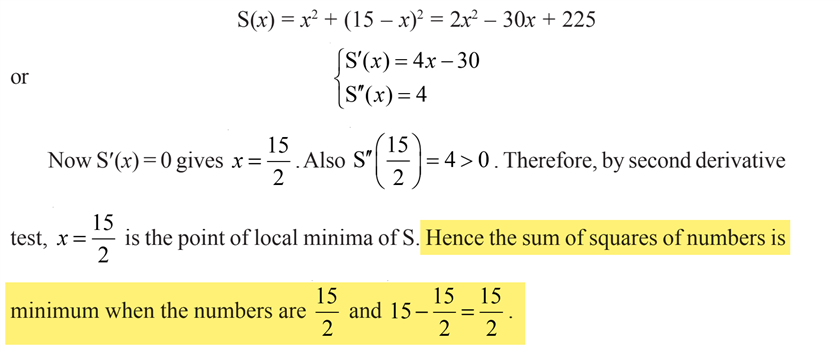
Let the numbers be x and \(16 - x\). The sum of their squares is
\(S = x^2 + (16 - x)^2\)
Setting the first derivative to zero:
\( \displaystyle \frac{dS}{dx} = 2x - 2(16 - x) = 4x - 32 = 0 \)
\(x = 8\)
By the second derivative test, \(\frac{d^2S}{dx^2} = 4 \gt 0\), so this is a minimum. The numbers are 8 and \(16 - 8 = 8\).
Shortcut: every pair in the options adds up to 16, so compare the sums of squares directly: \(36 + 100 = 136\), \(49 + 81 = 130\), \(64 + 64 = 128\), \(25 + 121 = 146\). The smallest is 128, for 8 and 8.
NCERT (2026-27 edition):
Maxima and Minima