Aldehydes and Ketones, having at least one methyl group linked to the carbonyl carbon atom (methyl Ketones), are oxidised by sodium hypohalite to sodium salts of corresponding carboxylic acids having one carbon atom less than that of carbonyl compound is converted to haloform. This oxidation does not affect a carbon–carbon double bond, if present in a molecule.
Predict the correct product (A):

Answer & explanation
Correct answer: option 2
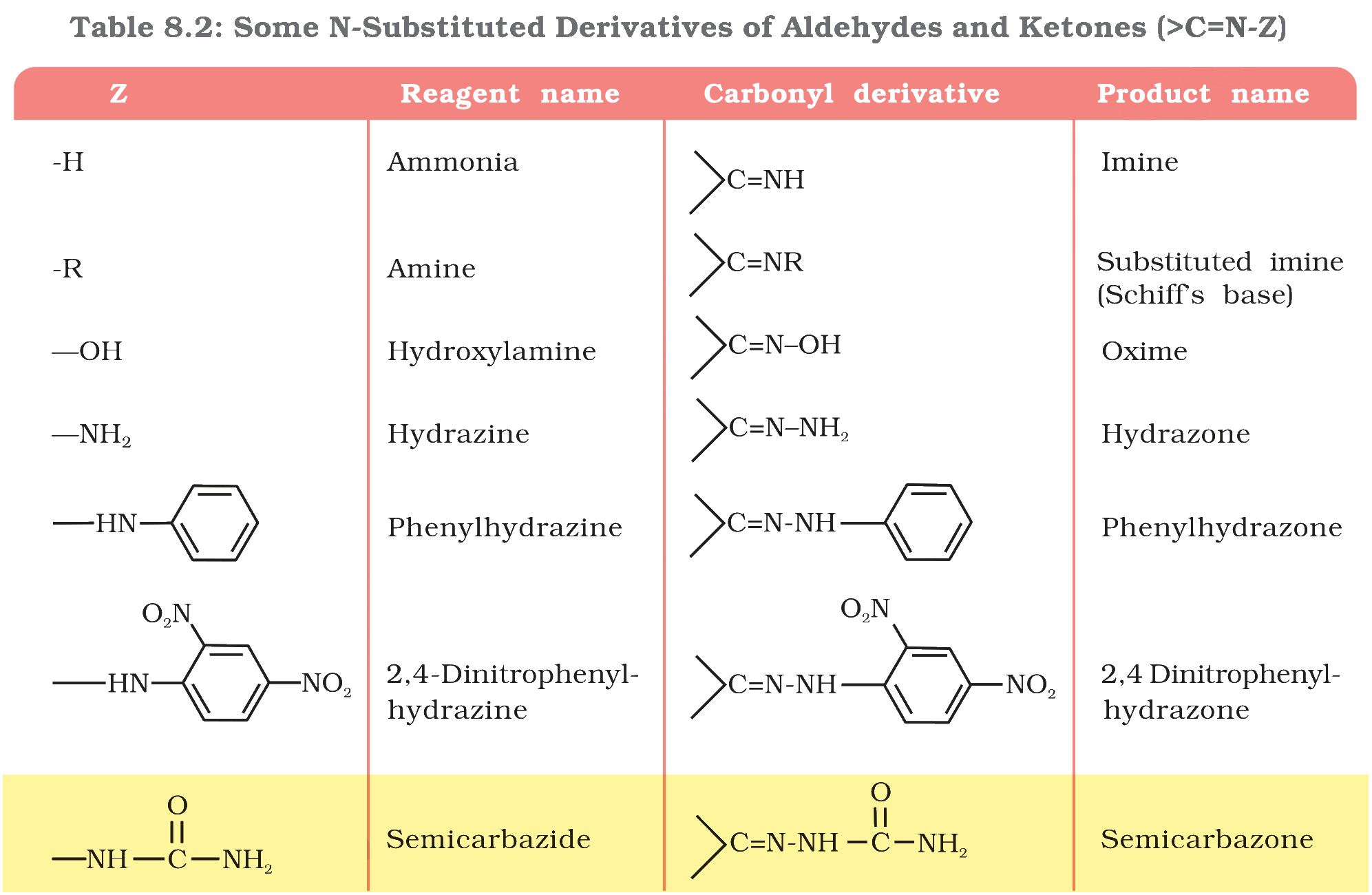
The correct answer is Option (2) → C6H5–CH=CH–CH=N–NH–CO–NH2 (the semicarbazone)
The reagent \( \ce{NH2-CO-NHNH2} \) is semicarbazide. Like other ammonia derivatives it adds to the C=O group of an aldehyde in weakly acidic medium and then loses water, giving a semicarbazone with a C=N bond.
Semicarbazide has two \( \ce{NH2} \) groups, but only the one on the hydrazine end (–NH–NH2) is nucleophilic; the lone pair of the \( \ce{NH2} \) next to C=O is delocalised into the carbonyl group (amide resonance). The C=C double bond of cinnamaldehyde is not attacked.
\( \ce{C6H5CH=CH-CHO + H2N-NH-CO-NH2} \xrightarrow{\ce{H+}} \ce{C6H5CH=CH-CH=N-NH-CO-NH2 + H2O} \)
Why the other options are incorrect
Option (1) C6H5CH=CH–CH=N–CO–NHNH2 — Incorrect. Here the aldehyde carbon is joined to the amide nitrogen, whose lone pair is tied up with C=O; this nitrogen does not attack.
Option (3) the carbinol + NH3+–CO–NHNH2 — Incorrect. This is not a reaction product; protonating semicarbazide only makes it non-nucleophilic, and the aldehyde is not reduced to an alcohol.
Option (4) addition across C=C with CHO intact — Incorrect. Ammonia derivatives react at the carbonyl carbon and give C=N, not addition to the C=C bond.
Note: It seems that there is a mistake in the original NTA paper, which prints “… than that of carbonyl compound is converted to haloform” when it should read “… than that of carbonyl compound. The methyl group is converted to haloform”.
NCERT (2026-27 edition):
Addition of Ammonia and Its Derivatives – …