
The solubility of a gas in a liquid
Answer & explanation
Correct answer: option 4
The correct answer is Option (4) → Increase with decrease of temperature
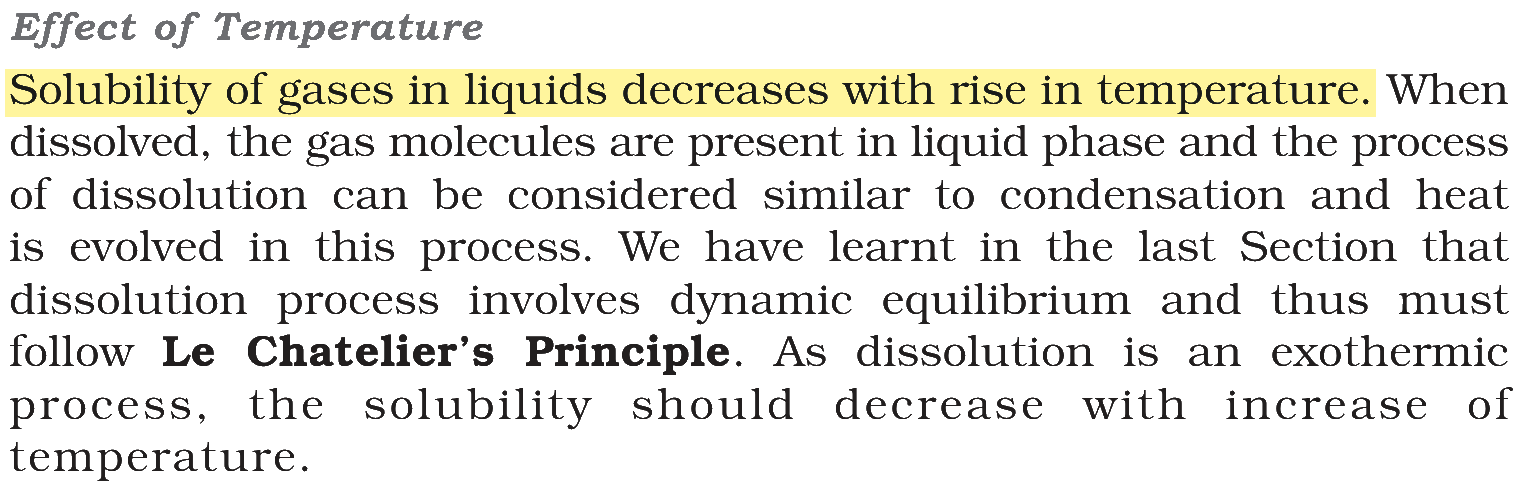
When a gas dissolves, its molecules pass into the liquid phase. Dissolution of a gas is exothermic. The dissolved gas is in dynamic equilibrium with the gas above the liquid:
\( \displaystyle \text{gas} + \text{solvent} \ce{<=>} \text{solution} \qquad \Delta H \lt 0 \)
So on heating, gas comes out of solution, and on cooling more gas dissolves (Le Chatelier’s principle). That is why bubbles appear when water is warmed, and why fish find less oxygen in warm water. So the solubility of a gas in a liquid increases with decrease of temperature.
Pressure acts the other way: by Henry’s law, the solubility of a gas increases with the partial pressure of the gas above the liquid.
Why the other options are incorrect
Option (1) Decrease with increase of pressure — Incorrect. By Henry’s law the solubility of a gas increases with pressure.
Option (2) Decrease with increase of both temperature and pressure — Incorrect. It is right for temperature but wrong for pressure; a higher pressure increases the solubility.
Option (3) Increase with increase of both pressure and temperature — Incorrect. It is right for pressure but wrong for temperature; gases dissolve with release of heat, so a higher temperature lowers the solubility.
NCERT (2026-27 edition):
Effect of Temperature
Note: The same/similar question has been asked in different years by NTA as per the details given below:
| 2026 | 2025 | 2024 | 2023 | 2022 |
|---|---|---|---|---|
| – | 24-05 S2 | – | 21-05 S3 | – |