
In an octahedral weak ligand field, each t2g electron lowers the energy by 0.4Δo and each eg electron raises it by 0.6Δo (pairing energy ignored). Match List-I (metal ion configuration in the weak ligand field) with List-II (crystal field stabilisation energy).
| List-I | List-II |
| (A) d4 | (p) 0 |
| (B) d5 | (q) −0.4Δo |
| (C) d6 | (r) −0.6Δo |
| (D) d7 | (s) −0.8Δo |
Choose the correct answer from the options given below:
Answer & explanation
Correct answer: option 2
The correct answer is Option (2) → A-r, B-p, C-q, D-s
In an octahedral field the d orbitals split into a lower t2g set and a higher eg set. The (2/5)Δo and (3/5)Δo are the 0.4Δo and 0.6Δo given here, so the crystal field stabilisation energy is:
\( \displaystyle \text{CFSE}=(-0.4\,n_{t_{2g}}+0.6\,n_{e_g})\,\Delta_o \)
In a weak ligand field \( \Delta_o \lt P \), so the electrons fill all five orbitals singly before any pairing (high spin): the fourth and fifth electrons go to eg, and the sixth and seventh pair up in t2g.
(A) d4 — This matches (r) −0.6Δo. Configuration t2g3eg1.
\( \displaystyle \text{CFSE}=3(-0.4)+1(0.6)=-1.2+0.6=-0.6\,\Delta_o \)
(B) d5 — This matches (p) 0. Configuration t2g3eg2, one electron in each d orbital.
\( \displaystyle \text{CFSE}=3(-0.4)+2(0.6)=-1.2+1.2=0 \)
(C) d6 — This matches (q) −0.4Δo. Configuration t2g4eg2.
\( \displaystyle \text{CFSE}=4(-0.4)+2(0.6)=-1.6+1.2=-0.4\,\Delta_o \)
(D) d7 — This matches (s) −0.8Δo. Configuration t2g5eg2.
\( \displaystyle \text{CFSE}=5(-0.4)+2(0.6)=-2.0+1.2=-0.8\,\Delta_o \)
NCERT (2026-27 edition):
5.5.4 Crystal Field Theory – “Thus, the degeneracy of the d orbitals has been removed due to ligand electron-metal electron repulsions in the octahedral complex to yield three orbitals of lower energy, t2g set and two orbitals of higher energy, eg set. … Thus, the energy of the two eg orbitals will increase by (3/5) Δo and that of the three t2g will decrease by (2/5)Δo.”
“(i) If Δo < P, the fourth electron enters one of the eg orbitals giving the configuration t2g3 eg1. Ligands for which Δo < P are known as weak field ligands and form high spin complexes.”
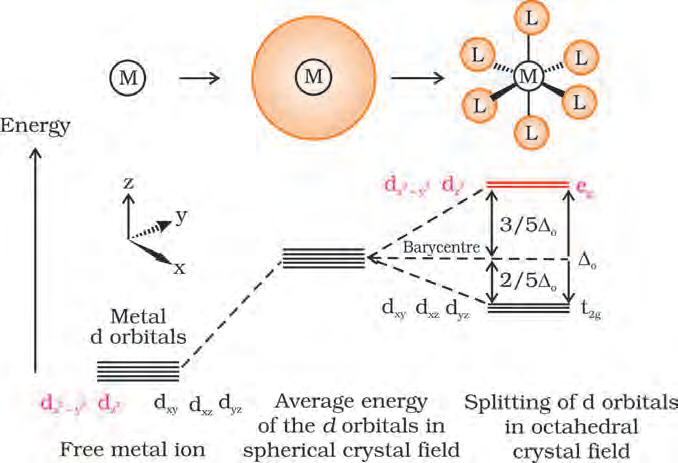
Fig. 5.8: d orbital splitting in an octahedral crystal field