
In the IUPAC system, aliphatic carboxylic acids are named by replacing the ending –e in the name of the corresponding alkane with –oic acid. In numbering the carbon chain, the carboxylic carbon is numbered one. For naming compounds containing more than one carboxyl group, the alkyl chain leaving carboxyl groups is numbered and the number of carboxyl groups is indicated by adding the multiplicative prefix, dicarboxylic acid, tricarboxylic acid, etc. to the name of parent alkyl chain. The positions of –COOH groups are indicated by the arabic numeral before the multiplicative prefix.
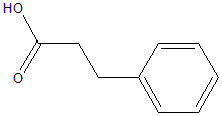
What is the IUPAC name of the given compound?
Answer & explanation
Correct answer: option 4
The correct answer is Option (4) → 3-Phenylpropanoic acid
The passage states that the acid is named from the alkane with the ending –e replaced by –oic acid, and that the carboxylic carbon is numbered one. The compound is \( \ce{C6H5-CH2-CH2-COOH} \).
Chain with the carboxyl carbon: COOH (C-1), CH2 (C-2), CH2 (C-3): three carbons, so propanoic acid.
Substituent: the benzene ring is a phenyl group on C-3.
Name: 3-phenylpropanoic acid.
Why the other options are incorrect
Option (1) 2-Phenylethanoic acid — Incorrect. This is \( \ce{C6H5CH2COOH} \) (phenylacetic acid), with only one CH2 between the ring and –COOH.
Option (2) 2-Phenylpropanoic acid — Incorrect. Here the phenyl group would be on C-2, the carbon next to –COOH, as in \( \ce{CH3-CH(C6H5)-COOH} \).
Option (3) 4-Phenylbutanoic acid — Incorrect. This needs a four-carbon chain, three CH2 groups between the ring and –COOH.