
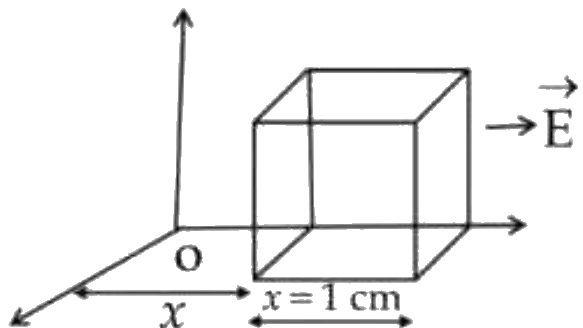
For the given diagram \( E = \phi x\,\mathrm{N/C} \), the net flux through the cube of side \( x = 1\,\mathrm{cm} \), placed \( x = 1\,\mathrm{cm} \) from the origin as shown is :
(E is acting towards positive \( x \)-axis and \( \phi = 1 \))
Answer & explanation
Correct answer: option 2
The correct answer is Option (2) → \( 1\times10^{-6}\,\mathrm{Wb} \)
The field points along \( x \), so only the two faces perpendicular to the x-axis carry flux; on the other four faces \( \vec{E} \) is parallel to the surface. The field is not uniform (\( E = x \) with \( x \) in metres), so the two faces carry different flux.
\( \phi = 1 \)
\( \mathrm{side} = 1\,\mathrm{cm} = 0.01\,\mathrm{m} \)
\( A = (0.01)^{2} = 1\times10^{-4}\,\mathrm{m^2} \)
The left face is at \( x = 0.01\,\mathrm{m} \) and the right face at \( x = 0.02\,\mathrm{m} \).
\( E_{\mathrm{left}} = 0.01\,\mathrm{N\,C^{-1}} \)
\( E_{\mathrm{right}} = 0.02\,\mathrm{N\,C^{-1}} \)
On the left face the field enters the cube (inward flux, negative); on the right face it leaves (outward flux, positive).
\( \displaystyle \Phi = E_{\mathrm{right}}A - E_{\mathrm{left}}A = (0.02 - 0.01)\times1\times10^{-4} \)
\( \displaystyle \Phi = 1\times10^{-6} \)
So the net flux is \( 1\times10^{-6} \) in SI units, which is Option (2).