
CUETMOCK
  • Pricing
  • Mentors
Log inStart freeStart free mocks→

First test, then trust

Try a free CUET mock test.

Join 5,00,000+ students who rehearsed exam day on the exact NTA screen before sitting CUET. On the web and on Android.

Start free mocks →Get the Android app
CUETMOCK

India's #1 CUET Mock Test Platform. Original NCERT-based questions on the exact NTA exam screen — trusted by 5,00,000+ students since CUET 2022.

Get it onGoogle PlayScan to download the CUETMOCK app

Mock tests

  • CUET mock test series
  • Commerce mocks
  • Humanities (Arts) mocks
  • Science mocks
  • Languages & GAT mocks
  • Free practice questions
  • Pricing

Resources

  • CUET exam guide
  • CUET syllabus
  • Universities accepting CUET
  • Expert blogs
  • News & notifications
  • Webinars & counselling
  • CUET score calculator
  • How we estimate your rank
  • FAQs

Company

  • About us
  • Our leadership & team
  • Our toppers
  • Mentors
  • For schools
  • Contact us
  • Terms
  • Privacy
  • Refund policy

Talk to us

+91 7696 6630 56info@cuetmock.comWhatsApp us

Our other platforms

  • JEE Mock — For IIT-JEE aspirants
  • NEET Mock — For NEET aspirants

Newsletter

Exam updates, study material and offers — no spam.

© 2026 NYC Ventures Pvt. Ltd.

701-702, Royal Business Park, Zirakpur, Punjab - 140603

  • Terms of use
  • Privacy policy
  • Refund policy
  • Contact us

iCUETMOCK is an independent preparation platform, not affiliated with the National Testing Agency (NTA). Always check exam details on the official NTA website.

  • Home
  • Mock tests
  • CUET guide
  • Pricing
  • Log in
Home/Practice questions/Biology
BiologyPrinciples of Inheritance and Variation

In snapdragon, a true-breeding red-flowered plant (RR) is crossed wit…

In snapdragon, a true-breeding red-flowered plant (RR) is crossed with a true-breeding white-flowered plant (rr). The pink-flowered F1 plants are self-pollinated. Which of the following correctly describes the F2 generation?

Answer & explanation+

Correct answer: option 3

The correct answer is Option (3) → Red, pink and white-flowered plants appear in the ratio 1 : 2 : 1, the same as the genotypic ratio.

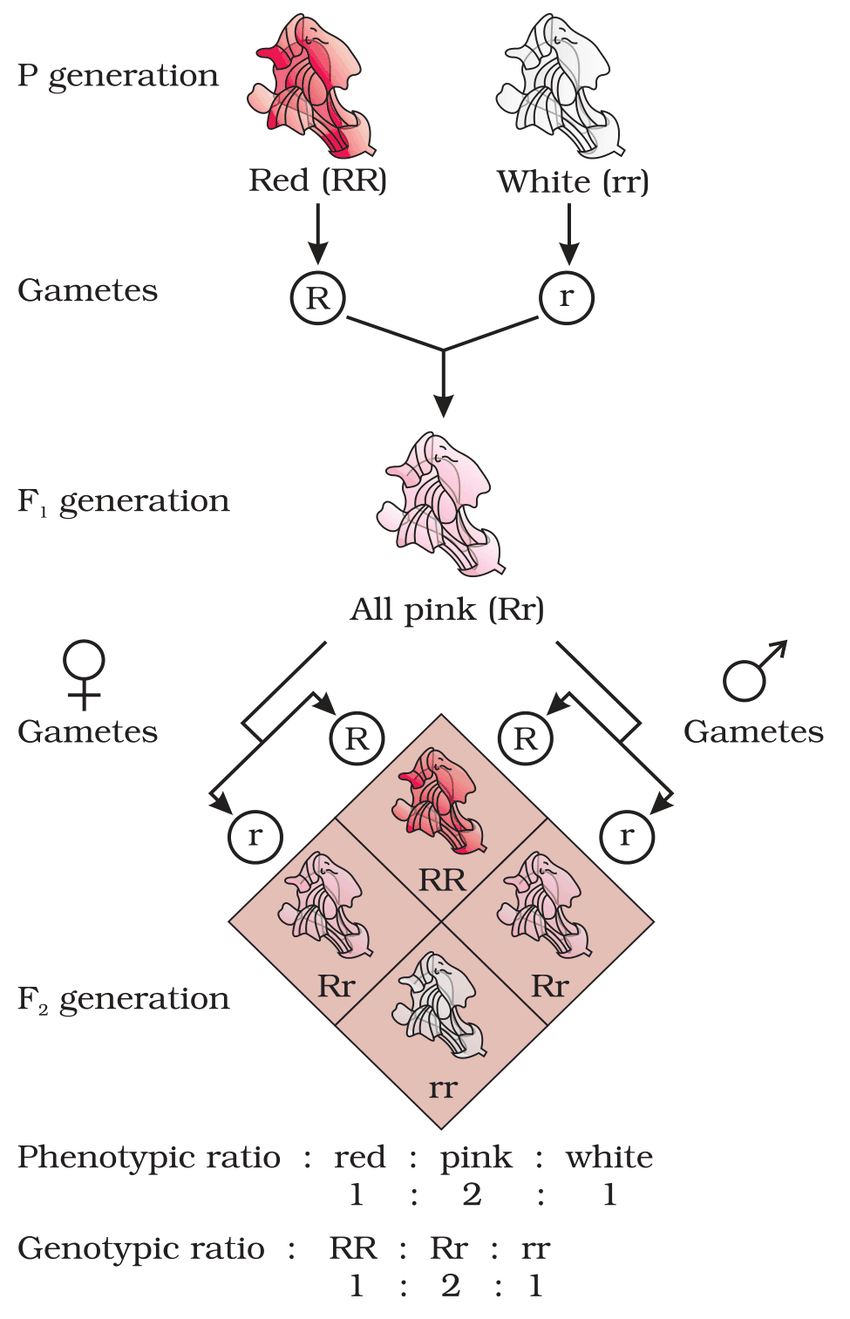
In snapdragon, R (red) is not completely dominant over r (white), so the heterozygote Rr is pink. When the pink F1 (Rr) plants are self-pollinated, the genotypes come out as in any monohybrid cross: 1 RR : 2 Rr : 1 rr. Because each genotype has its own colour, the phenotypes follow the same ratio.

 Rr
RRR (red)Rr (pink)
rRr (pink)rr (white)

Option (1) The F2 plants are pink-flowered, like the F1 plants. — Incorrect. Only the F1 is all pink. In the F2 the alleles segregate again, and red (RR) and white (rr) plants reappear.

Option (2) Red-flowered and white-flowered plants appear in the ratio 3 : 1, as in a mendelian monohybrid cross. — Incorrect. A 3 : 1 ratio appears only with complete dominance, where Rr would look like RR. Here Rr is pink, so it cannot be counted with the red plants.

Option (3) Red, pink and white-flowered plants appear in the ratio 1 : 2 : 1, the same as the genotypic ratio. — Correct. Red, pink and white plants appear in the ratio 1 : 2 : 1, the same as the genotypic ratio RR : Rr : rr.

Option (4) Pink-flowered and white-flowered plants appear in the ratio 3 : 1, as R is not completely dominant over r. — Incorrect. R is indeed not completely dominant over r, but that is why red, pink and white are all seen. Red plants (RR) also appear, so the ratio is not pink : white = 3 : 1.

NCERT Extract:
Incomplete Dominance – “… In a cross between true-breeding red-flowered (RR) and true-breeding white-flowered plants (rr), the F1 (Rr) was pink (Figure 4.6). When the F1 was self-pollinated the F2 resulted in the following ratio 1 (RR) Red: 2 (Rr) Pink: 1 (rr) White. Here the genotype ratios were exactly as we would expect in any mendelian monohybrid cross, but the phenotype ratios had changed from the 3:1 dominant : recessive ratio. What happened was that R was not completely dominant over r and this made it possible to distinguish Rr as pink from RR (red) and rr (white).”
Textbook figure

Figure 4.6 Results of monohybrid cross in the plant Snapdragon, where one allele is incompletely dominant over the other allele

Advertisement

Practise more on Principles of Inheritance and Variation

Chapter-wise mocks on the real NTA exam screen, with solutions and your rank. Your first mocks are free.

Start free mocks →

Advertisement

Next questions

  1. What material did P. V. Janakiram use to create the sculpture “Ganesha”?Fine Arts · The Modern Indian Art
  2. The Constituent Assembly was recognized by Section _________ of the Indian Independence Act, 1947.General Aptitude Test · General Knowledge
  3. At an inter-college fest, Aman keeps saying 'we' for students of his own college and 'they' for students of the rival college. Which of the…Psychology · Social Influence and Group Processes
  4. The left-hand derivative of f(x)=[x] sin π x at x=k, k being an integer, isMaths. Section B1 · Continuity and Differentiability
  5. Match List-I with List-IIList-IList-IITermsMeaning(a)Network(i)Well-connected through links(b)Nodes(ii)Made up of nodes and link(c)Develope…Geography · Fundamentals of Human Geography: Tertiary and Quaternary Activities
  6. Select the word which means the same as the group of words given. A person who draws or produces mapsEnglish · One Word
  7. In accounting, a transaction consists of data elements which includes: (A) Name of Account(B) Accounting Code(C) Date of Transaction(D) Amo…Accountancy Part C · Overview of Computerised Accounting System
  8. Match the laws in List I with the year adopted in List II LIST ILaws/ActsLIST IIYear of Adoption/PassingA.Caste Disabilities Removal ActI.1…Sociology · Indian Society: Patterns of Social Inequality and Exclusion
  9. Which of the following terms is NOT associated with Tennis?General Aptitude Test · General Knowledge
  10. Which one of the following depicts correct Percent Growth rate of India's Population during 2001-2011, as per census of India, 2011 (Provis…Geography · India-People and Economy: Population-Distribution,Density, Growth and Composition