CUETMOCK
  • Pricing
  • Mentors
Log inStart freeStart free mocks→

First test, then trust

Try a free CUET mock test.

Join 5,00,000+ students who rehearsed exam day on the exact NTA screen before sitting CUET. On the web and on Android.

Start free mocks →Get the Android app
CUETMOCK

India's #1 CUET Mock Test Platform. Original NCERT-based questions on the exact NTA exam screen — trusted by 5,00,000+ students since CUET 2022.

Get it onGoogle PlayScan to download the CUETMOCK app

Mock tests

  • CUET mock test series
  • Browse all papers
  • Commerce mocks
  • Humanities (Arts) mocks
  • Science mocks
  • Languages & GAT mocks
  • Free practice questions
  • Pricing

Resources

  • CUET exam guide
  • CUET syllabus
  • Universities accepting CUET
  • Expert blogs
  • News & notifications
  • Webinars & counselling
  • CUET score calculator
  • How we estimate your rank
  • FAQs

Company

  • About us
  • Our leadership & team
  • Our toppers
  • Mentors
  • For schools
  • Contact us
  • Terms
  • Privacy
  • Refund policy

Talk to us

+91 7696 6630 56info@cuetmock.comWhatsApp us

Our other platforms

  • JEE Mock — For IIT-JEE aspirants
  • NEET Mock — For NEET aspirants

Newsletter

Exam updates, study material and offers — no spam.

© 2026 NYC Ventures Pvt. Ltd.

701-702, Royal Business Park, Zirakpur, Punjab - 140603

  • Terms of use
  • Privacy policy
  • Refund policy
  • Contact us

iCUETMOCK is an independent preparation platform, not affiliated with the National Testing Agency (NTA). Always check exam details on the official NTA website.

  • Home
  • Mock tests
  • CUET guide
  • Pricing
  • Log in
Home/Practice questions/History
HistoryModern India: Framing the Constitution

Consider the following ideas regarding the national language carefull…

Consider the following ideas regarding the national language carefully. Find out which of these ideas were advocated by Mahatma Gandhi.

A. It should be Hindustani which should neither be Sanskritised Hindi nor Persianised Urdu, but a blend of both Hindi and Urdu.
B. It should not admit words from other different languages.
C. The national language must develop into a rich and powerful instrument, capable of expressing the thoughts and feelings of people.
D. It could unify Hindus and Muslims and people of North and South.

Choose the correct answer from the options given below:

Answer & explanation+

Correct answer: option 3

The correct answer is Option (3) → A, C, D only

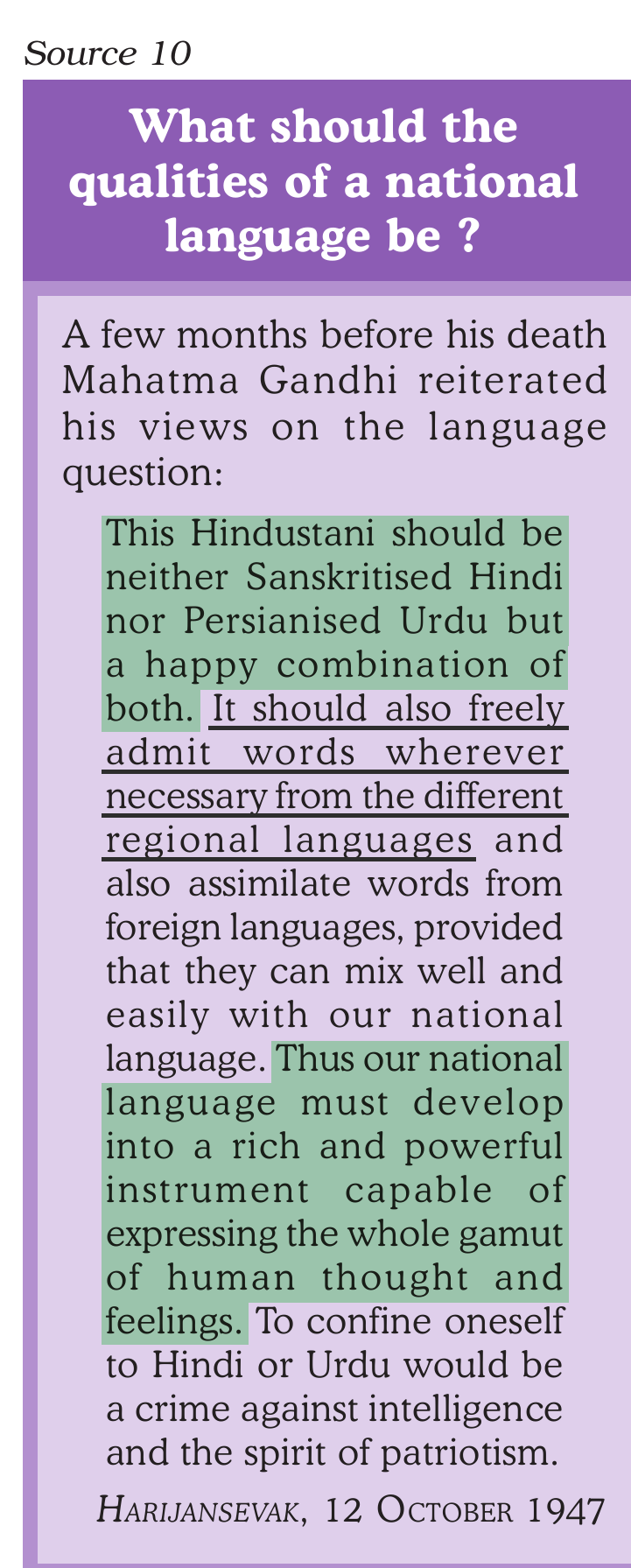
A. It should be Hindustani which should neither be Sanskritised Hindi nor Persianised Urdu, but a blend of both Hindi and Urdu. Correct. Mahatma Gandhi wanted Hindustani, neither Sanskritised Hindi nor Persianised Urdu but a happy combination of both.

B. It should not admit words from other different languages. Incorrect. Gandhiji held the opposite view. Hindustani should freely admit words wherever necessary from the different regional languages and also assimilate words from foreign languages, provided they mixed well with the national language.

C. The national language must develop into a rich and powerful instrument, capable of expressing the thoughts and feelings of people. Correct. In his words, the national language must develop into a rich and powerful instrument capable of expressing the whole gamut of human thought and feelings.

D. It could unify Hindus and Muslims and people of North and South. Correct. Gandhiji thought this multi-cultural language would be the ideal language of communication between diverse communities: it could unify Hindus and Muslims, and people of the north and the south.


NCERT (2026-27): “5. The Language of the Nation … By the 1930s, the Congress had accepted that Hindustani ought to be the national language. Mahatma Gandhi felt that everyone should speak in a language that common people could easily understand. Hindustani – a blend of Hindi and Urdu – was a popular language of a large section of the people of India, and it was a composite language enriched by the interaction of diverse cultures. Over the years it had incorporated words and terms from very many different sources, and was therefore understood by people from various regions. This multi-cultural language, Mahatma Gandhi thought, would be the ideal language of communication between diverse communities: it could unify Hindus and Muslims, and people of the north and the south.…”

NCERT extract

Advertisement

Practise more on Modern India: Framing the Constitution

Chapter-wise mocks on the real NTA exam screen, with solutions and your rank. Your first mocks are free.

Start free mocks →

Advertisement

Next questions

  1. Which one of the following statements is correct about the nature of globalization?Political Science · Contemporary World Politics: Globalisation
  2. Physics · Magnetism and Matter
  3. Which article of the Indian Constitution states that a Money Bill shall not be introduced in the Council of States?Political Science · Legislature
  4. Assertion: Species are groups of potentially interbreeding natural populations which are isolated from other such groups. Reason: Distincti…Biology · Organisms and Populations
  5. Arrange the following historical landmarks in chronological order, beginning with the earliest to the most recent.(A) Ahmad Shah Abdali def…General Aptitude Test · General Knowledge
  6. Painting in the Rajasthani courts was a kind of teamwork. What did the scribe do in it?Fine Arts · The Rajasthani Schools of Painting
  7. Increasing intergroup contact succeeds in handling prejudice only under certain conditions. How many of the following statements give such…Psychology · Attitudes and Social Cognition
  8. A researcher studying labourers' wages in Bengal villages in the late sixteenth century plans to use the Ain-i Akbari's price and wage list…History · Medieval India: Peasants, Zamindars and the State
  9. Arrange the following nuclei in increasing order of their binding energies per nucleon.A. ^3H B. ^4He C. ^12C D. ^56Fe Choose the correct a…Physics · Nuclei
  10. Who was at the forefront of the movement of the people of Hyderabad state against the Nizam’s rule?Political Science · Politics in India Since Independence: Challenges of nation Building